Teeth Whitening Kit 101: What Counts and What Doesn't
A teeth whitening kit is a packaged whitening application built from several parts: a whitening formulation in a measured container, a delivery interface that holds that formulation against the teeth, and — in most LED kits — a light, plus a shade guide and instructions. The formulation does the work; the tray, strip or brush-on powder is the delivery system; the shade guide is a reference point, not a promise of an outcome.
That definition sounds obvious until you look at how the term is actually used. In catalogues and search results, "teeth whitening kit" is stretched to cover toothpaste, toothpaste tablets, mouthwash, mouth spray, electric toothbrushes and oral irrigators. Several of those products do contain whitening ingredients and do use whitening language. GlorySmile's GS-007D double-tube toothpaste, for example, lists both hydrogen peroxide and PAP in its formula. It is still a toothpaste.
This guide draws the line. It explains what sits inside a kit, which formats belong to the category and which sit outside it, and why a formula decision — peroxide gel versus PAP gel, dry strip versus wet strip — is a separate question from a regulatory one. It is written for brand owners, importers and distributors at the research stage: deciding what belongs on a shelf and in a product line, before choosing a supplier.
The working definition: a dosed application with a fixed session
Four attributes separate a kit from a daily care item:
- A whitening agent in a measured dose. Kit gel ships in a syringe or pen, so the amount per use is set by the container. The GS-001Y kit, for instance, contains three 3 ml whitening syringes.
- A delivery interface. A mouth tray, an adhesive strip, or — for powders — direct brushing. The GS-001Y and GS-001B trays are made of food-grade TPE.
- A session protocol. GS-001Y uses a 10-minute light timer and is specified for 30 uses; GS-001B is specified for 40 uses of 10 minutes each; GS-001J is specified at 16 minutes per day.
- A shade reference. GS-001Y, GS-001B, GS-001J, DB-001M and GS-001X each include a shade guide in the box.
A toothpaste may carry the same class of ingredient, but the dose is whatever lands on the brush, the interface is the brush, and there is no timer or shade card. A mouthwash is a rinse. An electric toothbrush and an oral irrigator are devices that clean; neither delivers a whitening formulation. That is the practical test: dosed agent plus dedicated interface plus defined session. A product that fails one of the three belongs in daily care.
There is one place where the confusion is understandable: purple colour-correction. The GS-005V powder, the DB-007P toothpaste and the GS-006V serum all use purple, which the manufacturer describes as the complementary colour to yellow on the colour wheel, applied to cancel yellow undertones. That is an optical effect, not a whitening agent delivered through a tray or strip, which is why the word "purple" appears in both the daily care line and the whitening powder range. The pack and the mechanism decide the category, not the adjective.
What a kit contains: five configurations on the record
Published specifications for five GlorySmile kits show where configurations diverge — mainly in light count, power source and gel format, not in whether the product is a kit at all.
| Model | Light | Gel / pen format | Session and uses | Power |
|---|---|---|---|---|
| GS-001Y | 5 LED | 3 × 3 ml whitening syringes; 1 mouth tray (food-grade TPE) | 10-minute timer; 30 uses | 2 × CR2450 lithium metal |
| GS-001B | 5 LED | 3 whitening syringes (volume not stated in the specification); 1 mouth tray (food-grade TPE) | 10-minute sessions; 40 uses | 2 × CR2032 lithium metal |
| GS-001J | 16 LED | Gel (format not specified); custom gel ingredients available | 16 minutes per day | USB from phone, laptop or power bank; no built-in battery |
| DB-001M | 32 LED | 4 × 2 ml whitening pens; storage case with cable | 16-minute LED timer; up to 8 uses per charge | 450 mAh lithium ion; 2–3 hour charge |
| GS-001X | 32 LED | 2 × 3 ml whitening pens; charging and sterilization case | 16-minute LED timer; up to 5 uses per charge; 3-minute UV sterilization cycle rated 99.99% | 150 mAh lithium ion; 4 hour charge |
Two readings follow. First, light count and power source are engineering choices, not category definitions: a 5-LED battery kit and a 32-LED rechargeable kit are both kits. Second, electronics add obligations a toothpaste never has. The specification for GS-001J carries a 12-month electronic warranty, and battery-powered kits raise transport questions that should be settled with the freight forwarder before the purchase order, not after.
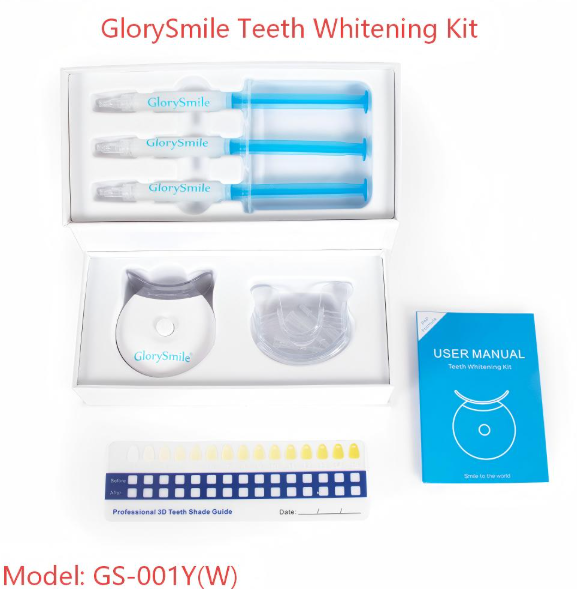
GS-001Y: 5-LED light, food-grade TPE mouth tray, three 3 ml whitening syringes, shade guide, manual and gift box.
Outside the boundary: six products that are not kits
The fastest way to test a listing is to ask what the product delivers and how. The table below uses products from the same manufacturer's range, which is exactly why the distinction matters commercially: one supplier can legitimately offer all of them.
| Product type | Example from the range | What it does | Why it is not a kit |
|---|---|---|---|
| Toothpaste | DB-007P purple colour corrector (65 g / 120 g); GS-007D double tube (100 g, hydrogen peroxide and PAP); GS-007F fruity (60 g, free of SLS, PEGs and added sugar, not tested on animals) | Brushed onto the teeth during daily cleaning | Dose set by the user; no delivery interface; no session protocol |
| Toothpaste tablets | GS-008 (30 or 60 tablets; rectangular, round or oval; mint; plastic, glass or aluminum jar, or kraft bag) | Solid form of daily brushing | Same job as toothpaste in a different dosage form |
| Mouthwash | DB-010S (237 ml, alcohol-free, breath freshener and stain remover); DB-010P coconut (20 × 12 ml aluminum sachets) | Rinsed around the mouth | Liquid rinse; no tray or strip; no timed application |
| Mouth spray | GS-011 (17 ml; ten flavours including mint, lime, peach, chocolate, vanilla, banana, grape, peppermint, coconut and kiwifruit) | On-the-go breath freshness | Breath product; no whitening delivery |
| Electric toothbrush | GS-K5 (five modes rated 39,000–43,000 times/min, 600 mAh, up to 60 days per charge, USB-C charge in 3–4 hours) | Powered cleaning | Device; delivers no whitening formulation |
| Oral irrigator | GS-V2 (280 ml PP tank, four modes, 20–120 PSI, 800 mAh, up to 65 days per charge) | Interdental cleaning and gum massage | Device; uses water, not whitening gel |
Two further items appear in the same catalogue and should not be mistaken for kits either: the GS-008D denture cleansing tablet, which is specified for dentures, mouthguards and retainers, and the GS-009 silicone dental impression putty, a clinic material for taking impressions. Both sit in oral care; neither whitens teeth.
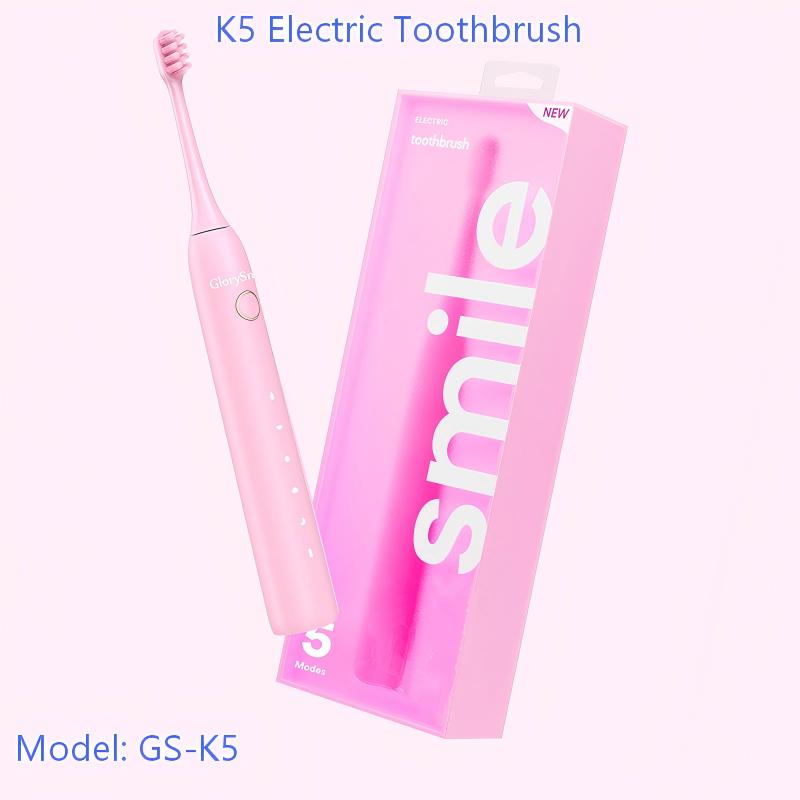
The K5 Electric Toothbrush cleans; it does not deliver a dosed whitening formulation.
Inside the category: four format families
1. LED gel kits — the multi-component format
This is the configuration most people mean by the term: light, tray, gel and shade guide in one box. The formula list for GS-001Y covers hydrogen peroxide, carbamide peroxide, PAP, sodium phytate, sodium bicarbonate, charcoal or a custom option; trays are food-grade TPE; packaging is a hard cardboard box. At the upper end the box gains a charging and sterilization case, as on GS-001X. For a private-label programme, the customization levers are packaging, gel ingredients and syringe or light colour.
2. Whitening strips — wet, dry and dissolving
Strips are a single-component format with a gel layer and no light or tray. The differences inside that format are real, and they change the user routine:
- Wet strips. GS-V34-S07 ships 7, 14 or 21 bags per pack, with formula options including PAP, PAP plus charcoal, purple, 6% hydrogen peroxide, sodium phytate, sodium bicarbonate or custom, and twelve flavours from blue raspberry to coconut. The strip is three layers: PET hard film, whitening gel, PE soft film, packed in an aluminum bag.
- Dry strips.GS-004H/V/C/P is described as a high-viscosity, residue-free, alcohol-free dry strip, intended for dental and oral care applications.
- Dissolving strips. DB-004L uses the same three-layer construction but is specified as a dissolving strip, also in 7, 14 or 21 bags per pack.
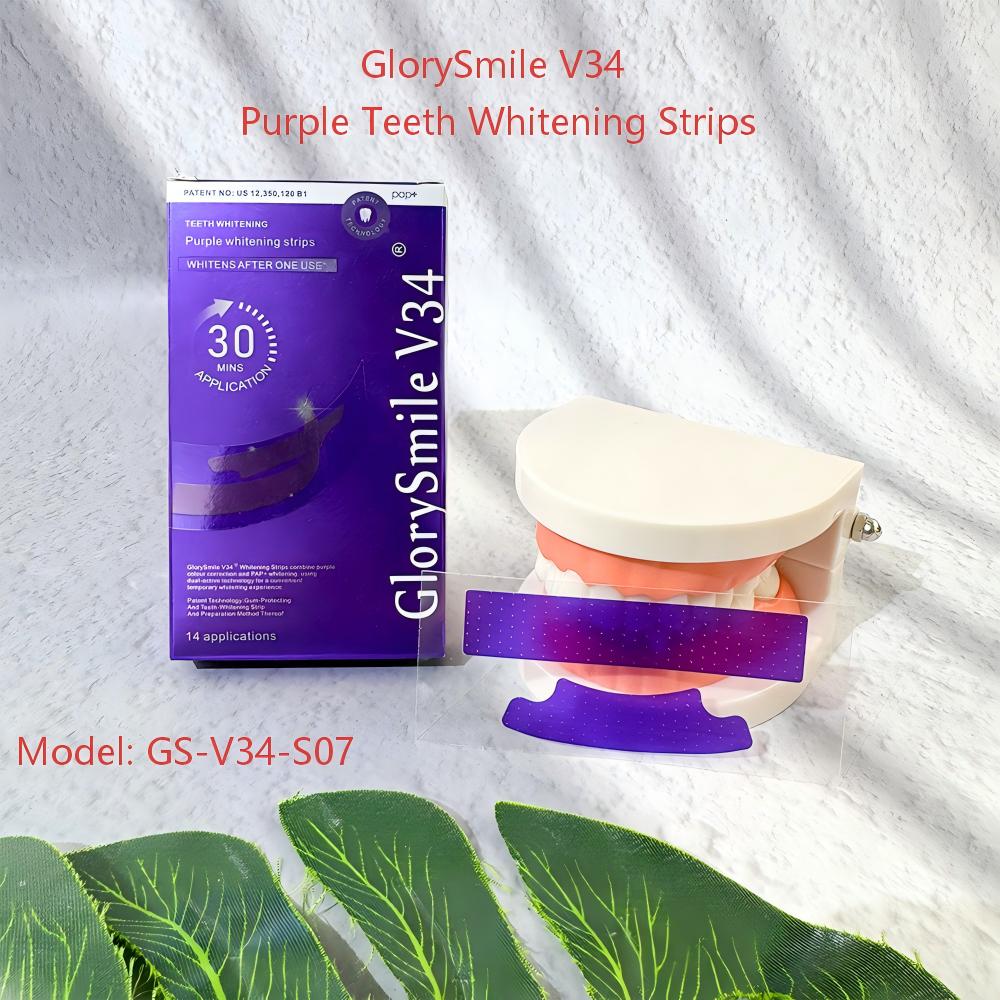
GS-V34-S07 purple wet strips: three-layer construction, aluminum bag, 7/14/21 bags per pack.
3. Whitening powder
Powder is applied by brush rather than held in a tray, so it is a whitening format without a delivery device. The range separates by mechanism: GS-005V is a purple colour corrector powder, GS-005C is a charcoal powder and GS-005P is a PAP+ powder. Net weights run from 12 g to 100 g depending on the model, and packaging can be a plastic jar, glass jar, aluminum jar or kraft bag.
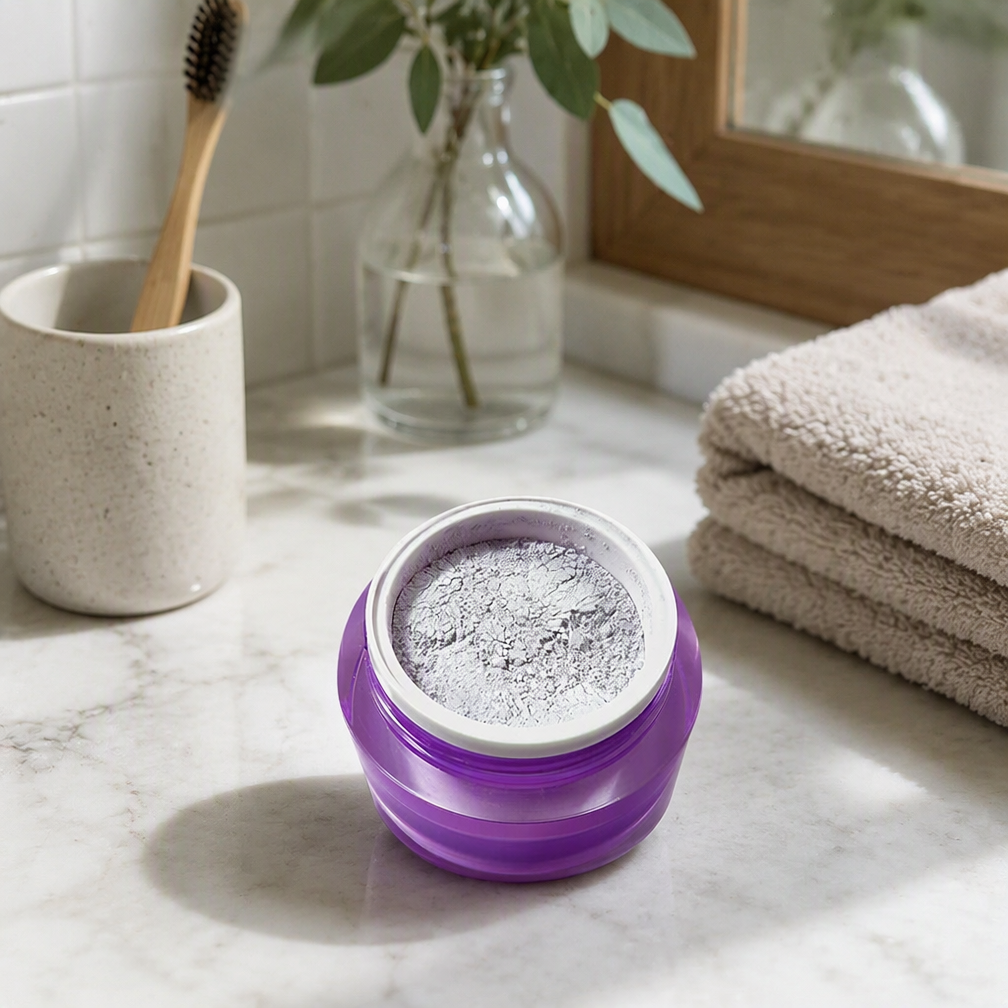
Whitening powder is brush-applied: a whitening format with no tray, strip or light.
4. Clinic kits
The GS-001L is classified as a clinic-use whitening kit and contains 35% hydrogen peroxide gel, a 5 ml dual-barrier whitening gel, a 3 ml gum protector, cheek retractor, brush ups, vitamin-E swabs, saliva towels, face gauze, a bib and an aluminum bag. The configuration itself — gum protector, retractor, bib — signals a supervised professional setting. That is a different buyer, a different order size and a different conversation from a retail take-home kit, even though both are called kits.
Formula and regulatory status are two different questions
The formula axis is straightforward. GlorySmile's product FAQ lists PAP as the peroxide-free option alongside carbamide peroxide and hydrogen peroxide, and the kit and strip specifications add sodium phytate, sodium bicarbonate, charcoal, purple and custom variants. That is a formulation menu.
The regulatory axis is not the same menu. Within the EU, Directive 2011/84/EU addresses teeth whitening products containing between 0.1% and 6% hydrogen peroxide and requires a first treatment by a dentist, as summarised in the regulatory source consulted for this article. A strip specification that lists "6% HP" as an option therefore states a concentration that the EU framework specifically addresses. The specification tells you the concentration. It does not tell you the product's classification, the document set required in a given market, or whether a particular retail channel will accept it.
Where buyers most often conflate the two: assuming "peroxide-free" equals a lighter regulatory burden, or that a "PAP+" label is itself a compliance status. Neither follows. PAP is a formulation choice; classification and documentation are separate determinations made per market and per product, and they should be confirmed in writing rather than inferred from a product name.
Dry versus wet versus dissolving is a third, separate decision — a delivery choice rather than a formula or regulatory one. Dry strips are described as high-viscosity and residue-free, wet strips carry a gel layer, and dissolving strips disappear in place. None of those descriptions changes what the formulation contains or which documents the product needs.
One technical reference is worth keeping in the file. The US FDA recognises ISO 28399:2021 as a consensus standard for external tooth bleaching products, which makes it a useful shared vocabulary when discussing test methods with a laboratory. A recognised standard is a reference point, not a certificate held by a product.
On demand, The Insight Partners describes rising interest in PAP+ peroxide-free kits as an alternative to peroxide, linked to sensitivity concerns. That is commercial research with medium confidence, and it should be read as a directional signal rather than a measured share. The factory-side version of the same signal is simpler: its FAQ states that PAP and low-sensitivity formulas are offered for sensitive teeth. "Peroxide-free" and "enamel-safe" remain label claims that need to be tied to a specific formula and to the documentation supplied for it.
What the boundary changes for a brand or importer
- Assortment and claims. A kit is a treatment purchase; toothpaste, mouthwash and tablets are repeat daily purchases. They should not share claim wording, because the kit's claim depends on formula, concentration and market, while a daily product's claim is built around cleaning and freshness.
- Customs treatment. A US Customs and Border Protection ruling (NY N342147, 13 September 2024) classified teeth whitening strips imported from China under subheading 3306.90.0000, applying GRI 3(b) and treating the strips as giving the goods their essential character. A kit that adds a light, tray and syringes is a different article; classification should be reviewed for the kit rather than copied from the strip ruling.
- After-sales structure. Electronic components create warranty and service obligations. The GS-001J specification states a 12-month warranty on electronics, and the same 12-month electronic warranty appears across the device range.
- Market context for planning. Fortune Business Insights valued the global teeth whitening market at USD 8.93 billion in 2025 and projects USD 14.31 billion by 2034. Straits Research puts the at-home or individual segment at 68.67% of the market in 2024, which is the segment a kit programme competes in. Regional leadership is less settled: one source places Asia-Pacific first with 33.80% in 2025, while other estimates put North America ahead depending on whether in-office dental services are counted. Use these figures for orientation, not for a business case.
Documents buyers ask for — and what each one does not establish
Compliance questions arrive quickly once a kit is on the table. The useful habit is to separate the document from the conclusion it supposedly supports.
| Requested item | What GlorySmile states it can provide | What it does not establish on its own |
|---|---|---|
| MSDS | MSDS is available on request | A market authorisation or a classification decision |
| EU cosmetic documents | CPSR, CPNP and PIF for cosmetic products | Coverage of a SKU supplied as a medical device |
| EU medical device route | CE-MDR registration stated as completed for medical devices | That a cosmetic-classified kit follows the same route |
| FDA-related scope | Factory FAQ states its FDA certification scope covers medical devices, cosmetics and OTC drugs | Which certificate names your exact model and configuration |
| US registration questions | Addressed through the factory's documentation process | A conclusion you can publish without confirming classification |
| System certificates | MDSAP, ISO 13485, ISO 22716, US GMP, BSCI, HALAL and Vegan; medical device and cosmetics production licences | Product-level approval in a specific market |
The pattern is consistent: a factory certificate describes a facility or a system, while a product document describes a SKU. Ask for the document that names the product and the configuration you intend to import, check its scope and validity, and keep the answer in writing. This is also the honest way to handle MoCRA-related questions from US buyers: the applicable registration and listing documents depend on how the product is classified, so they should be confirmed per SKU rather than assumed from the category.
A six-step brief for specifying a kit
- Decide the job. Treatment or maintenance. If the answer is maintenance, you are buying toothpaste, tablets, mouthwash or a device — a different line item with a different claim set.
- Fix the formula axis. Hydrogen peroxide, carbamide peroxide, PAP or a custom formula, and the concentration you are willing to defend in the target market.
- Fix the delivery. Tray plus light, wet strip, dry strip, dissolving strip or powder. Session length belongs here: 10 minutes on GS-001Y and GS-001B, 16 minutes on GS-001J, DB-001M and GS-001X.
- Fix the configuration. Light count, battery type or USB power, pen or syringe volume, tray material, case or gift box.
- Fix the document set. MSDS, CPSR, CPNP, PIF, CE-MDR, FDA and US registration questions — requested per SKU, in writing.
- Fix the commercial terms. MOQ per SKU, customization scope for gel, colour and packaging, and the warranty that applies to any electronic part.
Where GlorySmile sits in this category
GlorySmile is the brand of Jiangxi DentalBright Technology Co., Ltd., a Chinese oral care manufacturer founded in 2008 with its current factory completed in 2013. Because it produces kits, strips, powders and daily care items under one roof, it is a useful reference point for the boundary this article describes — the same supplier can quote a 5-LED kit, a 7-bag strip pack and a 237 ml mouthwash without any of them becoming the same product.
On capacity, the company reports 10,000,000 sets of teeth whitening kits, 300,000,000 pieces of whitening strips and 18,000,000 boxes of whitening powder per year, alongside 20,000,000 whitening pens, 30,000,000 toothpastes and 150,000,000 toothpaste tablets. The site covers 36,000 m², including 20,000 m² of 100,000-class cleanrooms and a 1,000 m² laboratory with a 100-class cleanroom for microbiological testing. The team is 256 people, including 17 R&D engineers, 11 QC specialists, 8 production management staff and a 6-person packaging design team. Exports account for 90% of output across the EU, USA and UK, with distribution to 102 countries. Certifications listed are MDSAP, ISO 13485, ISO 22716, US GMP, BSCI, HALAL and Vegan, alongside medical device and cosmetics production licences. OEM/ODM support includes formulation and packaging customization, free sampling and package design.
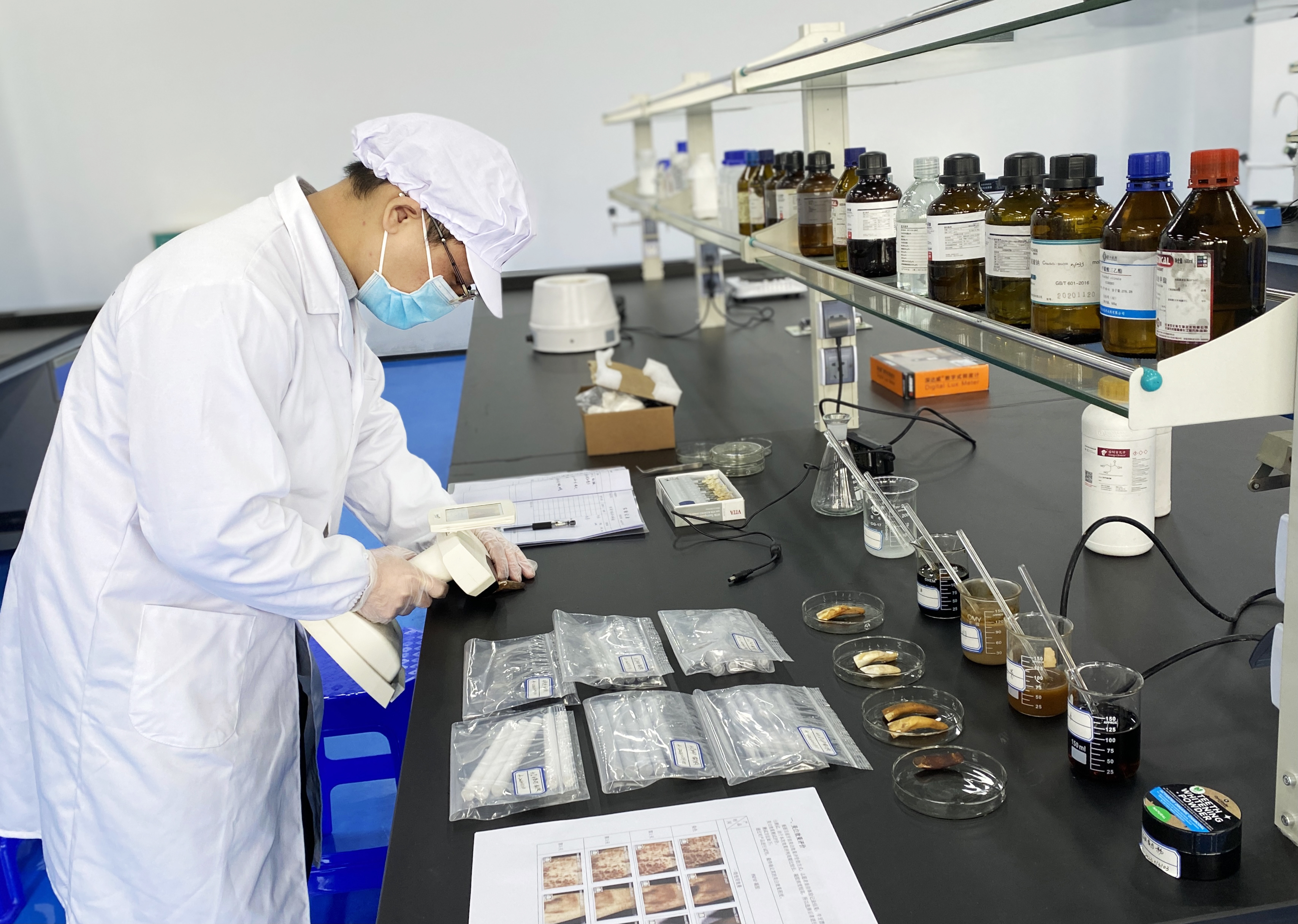
The R&D centre sits alongside a 1,000 m² laboratory with a 100-class cleanroom for microbiological testing.
FAQ
Which compliance documents should a buyer request for a teeth whitening kit?
Start with the document families that match the product's classification. GlorySmile states that it can offer CPSR, CPNP and PIF for cosmetic products, that CE-MDR registration is completed for medical devices, and that MSDS is available. At factory level the company lists CE, FDA, CPSR, CPNP, PIF, SCPN, MSDS, COA, RoHS, HALAL and Vegan certificates, plus GMP, ISO 22716, ISO 13485, MDSAP and BSCI for systems. None of those names tells you which document covers your model, so ask for the one that names the product and check its scope and validity.
Is a whitening strip or whitening powder the same product as a teeth whitening kit?
They are related formats with different configurations. A kit bundles a light, a tray, gel in syringes or pens and a shade guide — GS-001Y contains a 5-LED light, one mouth tray, three 3 ml whitening syringes, a shade guide, a manual and a gift box. GS-V34-S07 strips ship 7, 14 or 21 bags per pack with their own formula and flavour options, and the GS-005 series powders run from 12 g to 100 g. If the listing promises a kit, the box must contain the multi-part system.
Does switching from peroxide to PAP change the regulatory status?
It changes the formulation, not the classification by itself. The formula options on record include hydrogen peroxide, carbamide peroxide and PAP (peroxide-free), plus sodium phytate, sodium bicarbonate, charcoal or custom. Concentration is one input rather than the answer: under Directive 2011/84/EU, EU products containing between 0.1% and 6% hydrogen peroxide require a first treatment by a dentist. Whether a specific SKU is treated as a cosmetic or a medical device, and which documents apply, is decided per market and should be confirmed in writing before claims are printed.
How do I shortlist teeth whitening kit manufacturers?
Check four things in order. First, the configuration can be documented: light count, power source, gel volume and tray material, as on GS-001Y with its food-grade TPE tray. Second, the formula menu is real, covering hydrogen peroxide, carbamide peroxide, PAP and custom options rather than one unverifiable "advanced formula". Third, capacity fits your forecast: GlorySmile, for example, reports annual output of 10,000,000 teeth whitening kit sets, 300,000,000 strips and 18,000,000 boxes of powder. Fourth, the document set can be produced per SKU. Then request a sample of the exact configuration you intend to sell.
What formulation options exist for sensitive-teeth positioning?
The factory FAQ states that PAP and low-sensitivity formulas are designed for sensitive teeth. On the record, kit gel options include hydrogen peroxide, carbamide peroxide, PAP, sodium phytate, sodium bicarbonate, charcoal and custom, while strip options include PAP, PAP plus charcoal, purple, 6% hydrogen peroxide, sodium phytate and sodium bicarbonate. "Peroxide-free" and "enamel-safe" are claims that should be tied to the specific formula and to the documentation supplied for that formula.
What is the MOQ for a private-label teeth whitening kit?
It is quoted per SKU and depends on configuration, gel and packaging. As published, GS-001Y lists 200 pcs for private label and 1 for the regular product, and the whitening powder range lists the same 200 pcs / 1 pc split. Customization scope — gel ingredient, syringe colour, packaging format — is what usually moves the number, so confirm the figure in the quotation rather than assuming one MOQ across the range.
Can I request a sample before placing an order?
Yes. Free sampling and package design are listed among the OEM/ODM services, and the typical route is a sample of the exact configuration, followed by a private-label quotation against the published minimum. For a teeth whitening kit programme, contact Tasha at tasha@enjoywhite.com or +86 177 7911 0152 (WhatsApp on the same number); the company catalogue is available for download here: GlorySmile product catalogue.
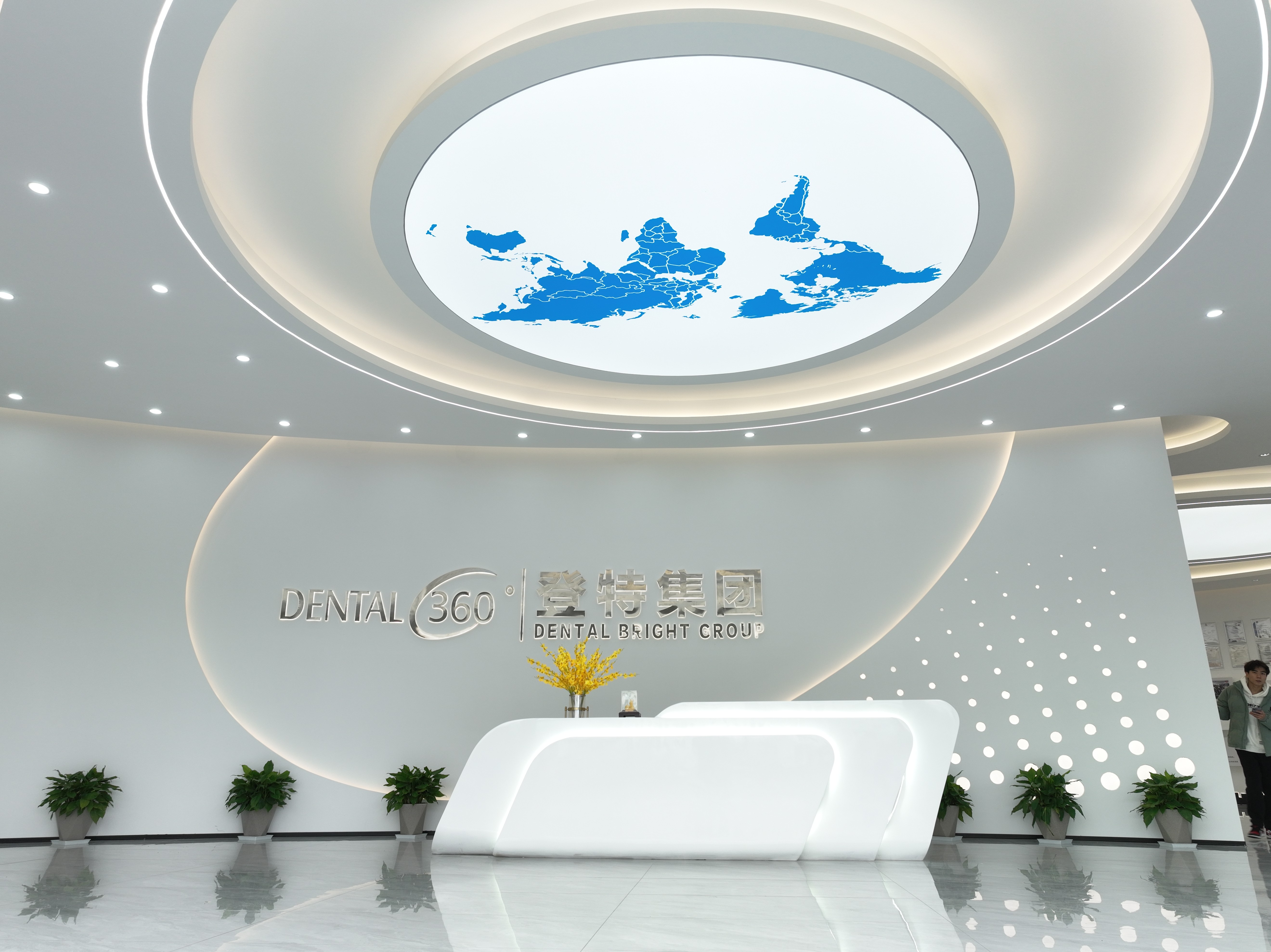
Sample requests and factory visits are handled through the Jiangxi facility, 15 minutes from Nanchang Changbei International Airport.
The boundary in one paragraph
A teeth whitening kit is defined by what it delivers and how: a measured whitening formulation, a dedicated delivery interface, and a session with a stated duration, usually supported by a shade guide. Toothpaste, toothpaste tablets, mouthwash, mouth spray, electric toothbrushes and oral irrigators are daily care products, even when they carry whitening ingredients or purple colour-correction. Strips, powders and clinic kits sit inside the whitening family but are not the same configuration as a multi-part kit. And the formula decision — peroxide versus PAP, dry versus wet — should be settled on its own terms, before the regulatory question is asked, because the two answers come from different documents and different evidence.
Have Questions or Need More Details?
Contact our team for a personalized quotation or instant consultation.
Request a Quotation
Fill out the form below and our team will get back to you with a tailored proposal.
WhatsApp Direct Chat
Prefer to chat in real-time? Message us on WhatsApp for instant assistance & quick answers.
- Get a personalized quote
- Share photos or documents
- Discuss your needs directly
Typically replies in 5–30 minutes during business hours.