Teeth Whitening Strips vs. Complete Kits: Making the Sourcing Decision for Your Brand
Choosing between teeth whitening strips and a complete all-in-one kit is a sourcing decision about components, packaging and compliance — not about which format whitens better. Strips leave the factory as a single consumable inside an aluminium bag and a printed colour box. A complete kit leaves as a light, a tray, a gel-delivery component, a shade guide, a manual and a gift box, and carries a longer bill of materials, a device-related compliance path and heavier packaging. Perceived consumer value, manufacturing complexity and packaging requirements decide the format; formulation decides the whitening claim, and it is specified separately.
This guide is written for brand owners, importers and distributors who have already decided to launch or extend a whitening line and now have to fix the SKU architecture. It compares the two formats only on variables that appear in a purchase order, a customs entry and a reorder — and it does not rank them on efficacy.
Both formats are produced by Jiangxi Dentalbright Technology Co.,Ltd., which trades as GlorySmile Factory, an oral care manufacturer based in Jiangxi Province, China, supplying teeth whitening strips, whitening kits and adjacent oral care products to export markets.
The decision buyers actually face
A brief that says “we want a teeth whitening kit” usually hides four separate decisions: what is inside the box, which compliance pathway applies, what the pack has to survive, and how the SKU repeats. Strips and complete kits answer those four questions differently, and the differences are structural rather than cosmetic.
- Choosing the kit for its shelf presence and costing packaging afterwards. A complete kit carries a hard cardboard gift box, a food-grade TPE tray, a printed manual and a shade guide. Those components are designed before they are priced, so the packaging budget has to be set at the same time as the component list.
- Choosing strips for simplicity and then needing a gift-ready unit. A strip SKU is an aluminium bag plus a colour box. If the channel wants a device in the box, the SKU has to be redesigned rather than re-labelled.
- Running two compliance files on one purchase order. Strips are handled as cosmetic products in several markets, while a kit containing a whitening light sits in medical-device territory. Each file is manageable on its own; mixing them without planning is where launches slip.
The practical formulation is to decide at SKU level, per channel, and to test that the decision still works at the second and third reorder — not only on the launch order.
Industry background: an at-home market where both formats compete
Fortune Business Insights valued the global teeth whitening market at USD 8.93 billion in 2025 and projects USD 14.31 billion by 2034. Straits Research places the individual / at-home segment at 68.67% of the teeth whitening market in 2024 — the shelf where strips and complete kits compete directly. The Insight Partners reports rising demand for PAP+ (phthalimidoperoxycaproic acid) peroxide-free systems as an alternative to traditional peroxide, driven by sensitivity concerns; that shift affects both formats, because the chemistry sits inside a bag of strips and inside a gel pen alike.
Regulation shapes format choice more than most buyers expect. Under Directive 2011/84/EU, products containing between 0.1% and 6% hydrogen peroxide require a first treatment by a dentist in the EU. The US FDA recognises ISO 28399:2021 as a consensus standard for external tooth bleaching products. US Customs ruling N342147 classifies teeth whitening strips imported from China under subheading 3306.90.0000, identifying the strip as the essential character of the set under GRI 3(b). The format you pick therefore determines both the document set and the duty line before artwork is approved.
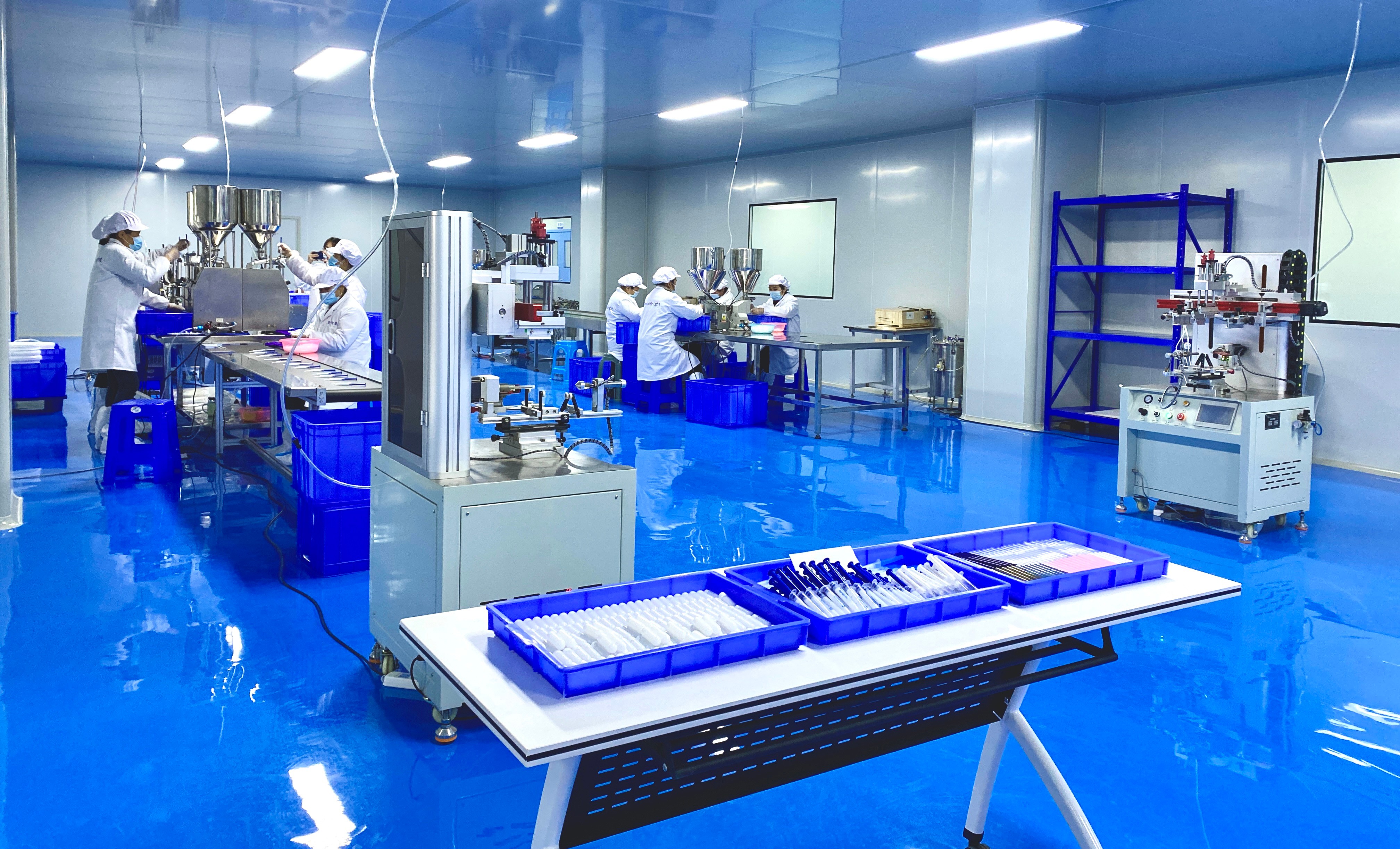
Production floor at the GlorySmile factory, where strip converting and kit assembly run under the same quality system.
Detailed solution: the four-lens decision model
Apply all four lenses. A format that passes three and fails one is a risk carried into production, not a preference.
Lens 1 — Perceived consumer value: count what is on the pack
Value at shelf is countable. In the GlorySmile range, the complete-kit models GS-001B and GS-001Y each contain one 5-LED whitening light, one mouth tray, three 3 ml whitening syringes, a shade guide, a user manual and a gift box. GS-001B is specified for 40 uses at 10 minutes per treatment; GS-001Y is specified for 30 uses with a 10-minute light timer. GS-001J contains a 16-LED light, four 2 ml whitening pens, a dust-free cover and four adapters (iPhone, Android, Type-C, USB), with 24 or 32 LEDs available as options. GS-001X pairs a 32-LED light with two 3 ml whitening pens and a charging and sterilisation case with cable; DB-001M pairs a 32-LED light with four 2 ml pens and a storage case.
Strip models follow a leaner logic. GS-004H/V/C/P, GS-V34-S07 and DB-004L are supplied as 7, 14 or 21 strip bags with a user manual, a shade guide and a colour box. The visible promise is treatment count and flavour rather than device count.
That difference is the first sourcing lever. A kit can support a deeper pack — more printed components, a tray, a gift box, a shade guide — while a strip SKU competes on count, flavour and price per treatment. Neither structure is inherently stronger. The workable rule is to write the shelf promise first and cost the bill of materials second, so the promise never outruns the components. Both formats accept custom packaging, custom formula and custom colour work.
Lens 2 — Manufacturing complexity: assembly versus converting
A complete kit is a multi-category assembly. It combines chemistry (gel in syringes or pens), electronics (LED array, battery, and on some models a charging case), plastics (food-grade TPE tray) and print (manual, shade guide, carton). The electronics differ by model: GS-001B runs on two CR2032 lithium metal batteries; GS-001Y on two CR2450 batteries; GS-001X on a 150 mAh lithium-ion battery with a four-hour charge, up to five uses per charge, a 16-minute timer and a three-minute auto-start disinfection cycle; DB-001M on a 450 mAh lithium-ion battery with a two-to-three-hour charge and up to eight uses per charge. GS-001J removes the battery entirely — it is plug-and-play over USB from a phone, laptop or power bank, with a recommended 16 minutes per day.
Tooling and IP sit on the kit side as well. GS-001X is covered by EU patent 015062946-0001 and UK patent 6370462; DB-001M by US design patent US D1,128,065 S, EU patent 015065790-0001 and UK patent 6377277. Buyers planning lookalike tooling should read those numbers before briefing a mould.
Strips are a converting product rather than an assembly. The strip is a three-layer construction — PET hard film, whitening gel and PE soft film — supplied as dry, wet or dissolving strips, with dry strips available in standard, alcohol-free, residue-free and high-viscosity variants. The bill of materials is short, but yield is decided by coating weight, lamination and pouch sealing, which is where specification discipline matters.
Capacity is the tie-breaker when both formats are on the table. Jiangxi Dentalbright Technology Co.,Ltd. lists annual output of 10,000,000 sets of teeth whitening kits and 300,000,000 pieces of teeth whitening strips, produced in a 36,000 m² facility that includes 20,000 m² of 100,000-class cleanrooms and a 1,000 m² laboratory with a 100-class cleanroom for microbiological testing. The team includes 17 R&D engineers, 11 QC specialists, 8 production management staff and a six-person packaging design team.
Lens 3 — Packaging requirements: the pack is the compliance object
For kits, the pack is a structural component: a hard cardboard gift box, a food-grade TPE tray, a printed manual, a shade guide, and on charging models a case and cable. For strips, the pack is a barrier: an aluminium bag inside a colour box, with an individually wrapped option listed for strip applications, plus enamel-safe and zero-peroxide options for markets that request them.
Customs and compliance then attach to the pack. US Customs ruling N342147 assigns strips from China to 3306.90.0000 because the strip carries the essential character of the set, so the strip SKU — not the shipper carton — drives classification. On documentation, GlorySmile has completed MoCRA-compliant cosmetic facility registration and product listing for teeth whitening strips for the US market, and holds CPSR, CPNP notification and an EU Responsible Person for cosmetic products in the EU. For kits, teeth-whitening lights, electric toothbrushes and oral irrigators hold FDA medical device registration, while medical-device products hold MDR-CE certification with a complete technical file and an appointed EU Responsible Person. Factory-level certificates include MDSAP, ISO 13485, ISO 22716, GMP and BSCI, alongside CE, UKCA, FCC and RoHS in the certification matrix.
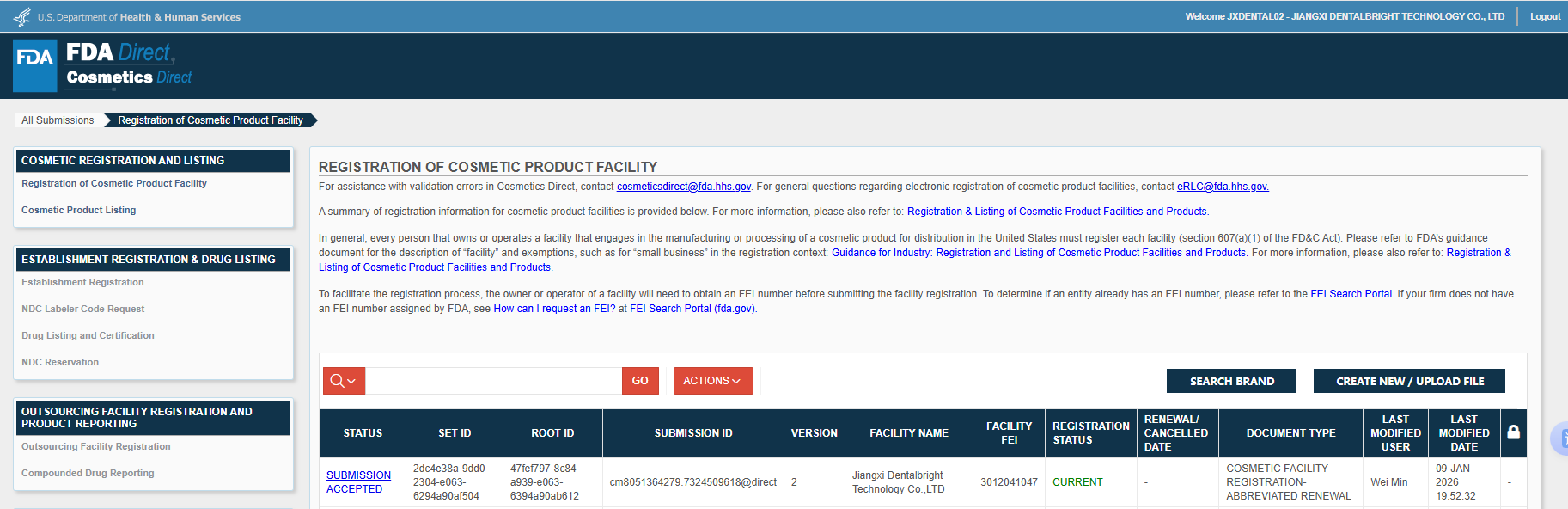
MoCRA-compliant cosmetic facility registration and product listing held for teeth whitening strips in the US market.
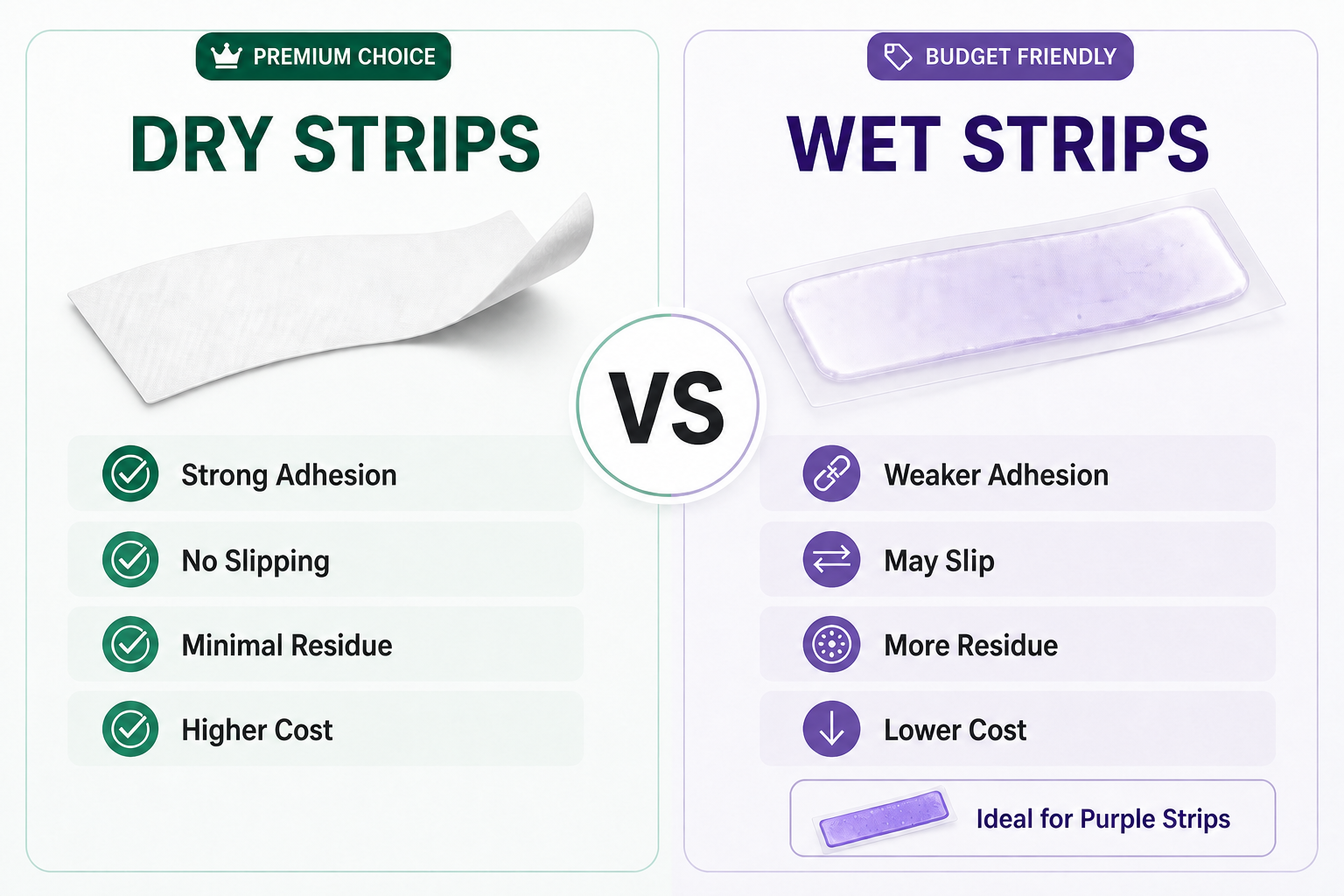
Dry strip and wet strip constructions: GS-004 series dry strips and GS-V34-S07 wet strips are both produced in the GlorySmile strip range.
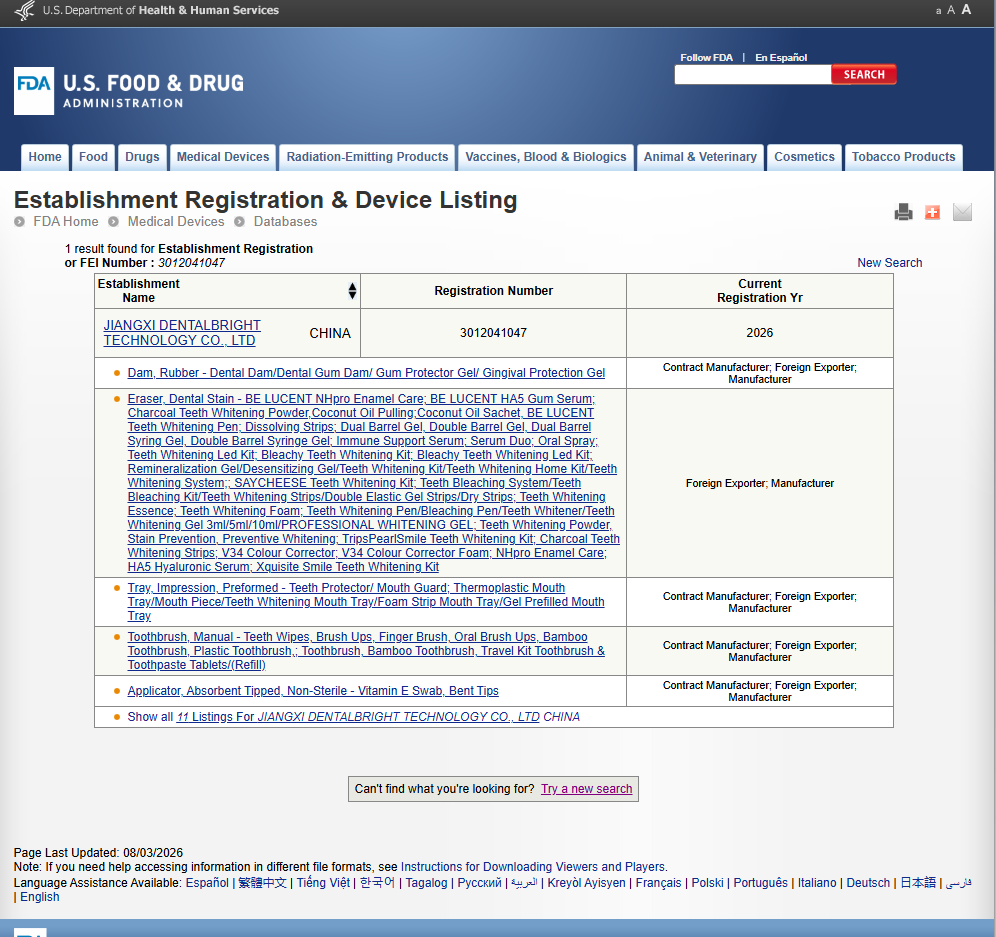
FDA medical device registration held for teeth-whitening lights, electric toothbrushes and oral irrigators.
Lens 4 — Long-term economics: how the SKU repeats
Strips repeat as consumables; kits repeat as a device sale followed by gel refills. That distinction shapes inventory planning more than unit price does. On the listed models, MOQ is 200 pieces for private label and 1 piece for regular products. The general purchasing terms state a standard-packaging MOQ of 5 boxes and OEM orders of 100 to 1,000 boxes, depending mainly on the minimum order quantity for the custom packaging. Delivery terms are EXW, FCA, FOB or CFR, with 30% deposit in advance and 70% balance before shipment.
Comparison material in the GlorySmile library gives an indicative spread rather than a quotation: strip pricing at USD 1.85–2.00 per box against a competing strip supplier, and medium-batch LED kit pricing at USD 6.85–7.98 per unit against a competing kit supplier. Both figures are useful for shaping a budget line and for stress-testing a retail price; neither replaces a formal quote built on your own component and pack specification.
The portfolio question matters for distributors. A basket that holds only strips is exposed to price competition on a single consumable; a basket that holds only kits carries more capital per SKU. The range supports both, plus adjacent lines that raise basket size: GS-007D double-tube toothpaste formulated with PAP and hydrogen peroxide, GS-007F fruity toothpaste, GS-005P PAP+ whitening powder, GS-005C charcoal whitening powder, DB-010S liquid mouthwash, GS-010F foam mouthwash, GS-011 mouth spray, and the GS-K5 and GS-K9P electric toothbrushes. Products are exported to 102 countries, with a 90% export ratio and main markets in the EU, USA and UK.
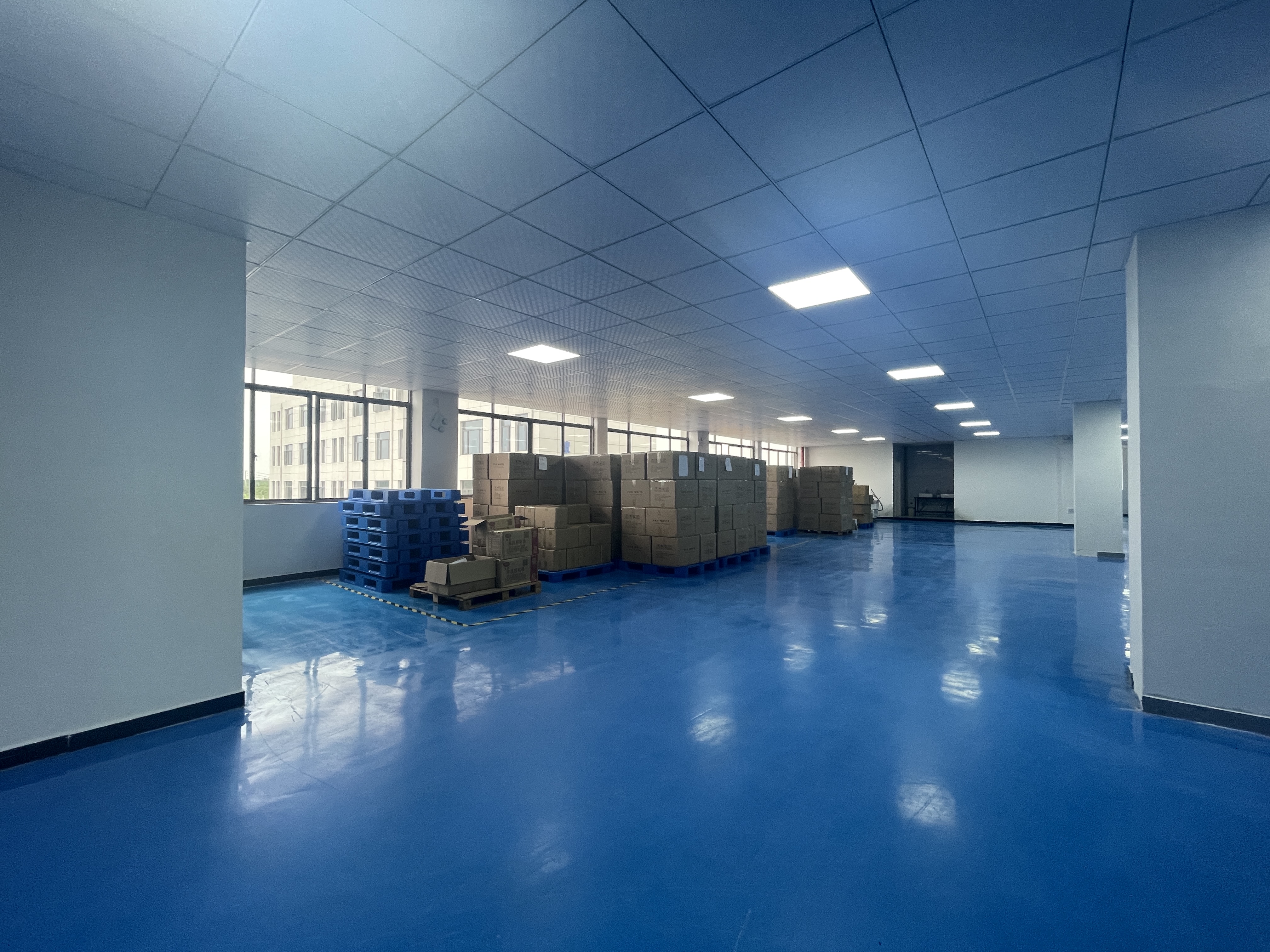
Finished goods and packaging components in the GlorySmile warehouse — the point where kit-heavy and strip-heavy baskets differ in working capital.
Step-by-step: a seven-step sourcing sequence
- Define the job of the SKU. Trial, gift, subscription refill or clinic take-home. The job decides whether the unit needs a device in the box.
- Lock the formulation and the claim first. PAP, hydrogen peroxide, carbamide peroxide or a peroxide-free system. The formula drives the compliance pathway and the artwork copy, so it cannot be decided after the pack is printed.
- Build the bill of materials and the pack together. For a kit, list light, tray, gel delivery, shade guide, manual, box, and case or cable where applicable. For strips, fix strip count (7, 14 or 21), film type and bag format.
- Set MOQ against cash, not against unit price. A 200-piece private-label run and a 1,000-box OEM run carry very different working-capital profiles for the same landed cost per unit.
- Validate a physical sample. Component fit, tray fit, shade guide print, carton strength and pouch seal are checked on the sample, not on the specification sheet.
- Design the reorder ladder. Decide before launch which refill pens or syringes the kit will carry, and which add-on SKUs attach to the strip line.
- Lock documentation and after-sales. Certificates, MSDS and COA on file; on-site inspection and pre-shipment random inspection agreed; a named account contact in place.
Use cases: where each format earns its place
- New brand with limited capital — strips. 7, 14 or 21 strip bags, 200-piece private label, and a lead time cited at 5–7 days keep the first order light.
- Premium or gift channel — a deep kit. GS-001X combines a 32-LED light with a charging and sterilisation case and carries EU patent 015062946-0001 and UK patent 6370462; DB-001M offers a 32-LED light with four 2 ml pens and a storage case.
- DTC subscription — kit plus refills. The kit is the entry unit, pens and syringes the repeat unit, and strips serve as a travel top-up.
- Clinic take-home — GS-001L. A clinic-use kit with 35% hydrogen peroxide dual-barrier gel, gum protector with two curved needles, cheek retractor, brush-ups, vitamin-E swabs, saliva towels, face gauze and bibs.
- Distributor portfolio — both formats from one quality system. Strips for volume and price-led listings, kits for value-led listings, with toothpaste, powder and mouthwash as attached lines.
Strips and complete kits, side by side
| Dimension | Teeth whitening strips | Complete all-in-one kit |
|---|---|---|
| Models in range | GS-004H/V/C/P (dry), GS-V34-S07 (wet), DB-004L (dissolving) | GS-001B, GS-001Y, GS-001J, GS-001X, DB-001M, GS-001L (clinic use) |
| Box contents | 7 / 14 / 21 strip bags, user manual, shade guide, colour box | LED light, mouth tray, 3 × 3 ml syringes or 2–4 × 2 ml pens, shade guide, manual, gift box; case and cable on charging models |
| Treatment specification | Strip count per bag sets the course length | GS-001B: 40 uses × 10 min; GS-001Y: 30 uses, 10-min timer; GS-001X: 16-min timer, 3-min disinfection cycle; GS-001J: 16 min per day |
| Power source | None | 2 × CR2032 (GS-001B), 2 × CR2450 (GS-001Y), 150 mAh Li-ion (GS-001X), 450 mAh Li-ion (DB-001M), USB plug-and-play (GS-001J) |
| Core construction | Three layers: PET hard film, whitening gel, PE soft film; dry, wet or dissolving | Food-grade TPE tray, LED electronics, battery or USB power, printed manual and shade guide |
| Primary pack | Aluminium bag plus colour box; individually wrapped option available | Hard cardboard gift box plus TPE tray, manual and shade guide |
| Customisation scope | Custom formula, flavour, strip count, carton | Custom packaging, gel formulation, pen or light colour, syringe colour |
| MOQ on listed models | 200 pcs private label / 1 pc regular product | 200 pcs private label / 1 pc regular product |
| Compliance lead item | MoCRA facility registration and product listing (US); CPSR, CPNP, PIF, EU Responsible Person (EU) | FDA medical device registration for whitening lights; MDR-CE with technical file and EU Responsible Person; MDSAP, ISO 13485, ISO 22716, GMP, BSCI |
| Reorder pattern | Pure consumable repeat | Device sale followed by gel refills (pens or syringes) |
| Indicative price, comparison material | USD 1.85–2.00 per box | USD 6.85–7.98 per unit, medium batch |
Frequently asked questions from distributors
Which compliance documents does each format need?
Strips are handled as cosmetic products in the markets we serve: MoCRA-compliant cosmetic facility registration and product listing for the US, and CPSR, CPNP notification, PIF and an EU Responsible Person for the EU. Kits that contain a whitening light sit in medical-device territory — our teeth-whitening lights hold FDA medical device registration, and medical-device products hold MDR-CE certification with a complete technical file and an appointed EU Responsible Person. Factory certificates including MDSAP, ISO 13485, ISO 22716, GMP and BSCI apply to both formats, and MSDS is available on request.
Can one supplier manufacture both strips and complete kits?
Yes. The GlorySmile range covers strips (GS-004H/V/C/P, GS-V34-S07, DB-004L) and complete kits (GS-001B, GS-001Y, GS-001J, GS-001X, DB-001M, GS-001L), plus toothpaste, whitening powder, mouthwash, mouth spray and electric toothbrushes. Annual output is 10,000,000 sets of teeth whitening kits and 300,000,000 pieces of teeth whitening strips, produced in a 36,000 m² facility with 20,000 m² of 100,000-class cleanrooms and a 1,000 m² laboratory. Jiangxi Dentalbright Technology Co.,Ltd. was founded in 2008, employs 256 people, and exports to 102 countries with a 90% export ratio.
What MOQ and payment terms should a distributor budget for?
Listed models carry an MOQ of 200 pieces for private label and 1 piece for regular products. Under the general purchasing terms, standard packaging starts at 5 boxes, while OEM orders run from 100 to 1,000 boxes depending mainly on the minimum order quantity for the custom packaging. Delivery terms are EXW, FCA, FOB or CFR, and payment is 30% deposit in advance with 70% balance before shipment.
How do samples and pre-production validation work?
Free sampling is part of the OEM/ODM service, and sample validation should cover component fit, tray fit, carton strength and pouch seal before a production order is released. We support on-site inspection, and our quality department can also carry out pre-shipment random inspection. Customer feedback across shipped programmes indicates a 99.8% positive feedback rate with no safety or compliance incidents.
What does a long-term wholesale partnership look like for distributors?
Cooperation is structured in three stages: small trial orders, medium-batch verification and mass production. Each client is assigned a dedicated account manager, with rapid after-sales feedback on quality complaints and flexible order follow-up for customised project adjustments. Lead time is cited at 5–7 days, and one retail programme delivered 7 million units with a zero return rate. To move from comparison to a decision, download the catalogue, request a sample of both the strip SKU and the kit SKU you are considering, or send your specification for a quotation.
Conclusion: decide the format, then specify the formulation
Strips and complete kits are not competing answers to the same question — they are two different SKU structures with different bills of materials, different pack costs and different documentation. Strips win where capital is limited, consumption is frequent and the listing is price-led. Complete kits win where the shelf needs a device, a gift box and a multi-component ritual, and where the buyer can maintain a device compliance file alongside the cosmetic one. Both are manufactured in the same facility, on the same quality system, with the same MOQ entry point of 200 pieces for private label.
The decision sequence that holds up in practice is short: define the job of the SKU, lock the formulation, cost the pack and the components together, then check that the reorder works. Whichever format you choose, the specification — film type, gel chemistry, battery, carton, certificate — is what actually gets produced.
Next step: sample the format you are evaluating
Compare both structures with physical samples before committing to tooling or artwork. GlorySmile supplies strip and kit samples, packaging dielines and the current catalogue with full specifications, MOQ and certification notes.
Catalogue:Download the GlorySmile product catalogue (PDF)
Website:www.glorysmile.com
Contact: Tasha — tasha@enjoywhite.com — Tel / WhatsApp +86 177 7911 0152
Address: Makou Industrial District, Yongxiu Town, Nanchang (Jiujiang) City, Jiangxi Province, China
Factory visits are welcome; the site is a 15-minute drive from Nanchang Changbei International Airport.
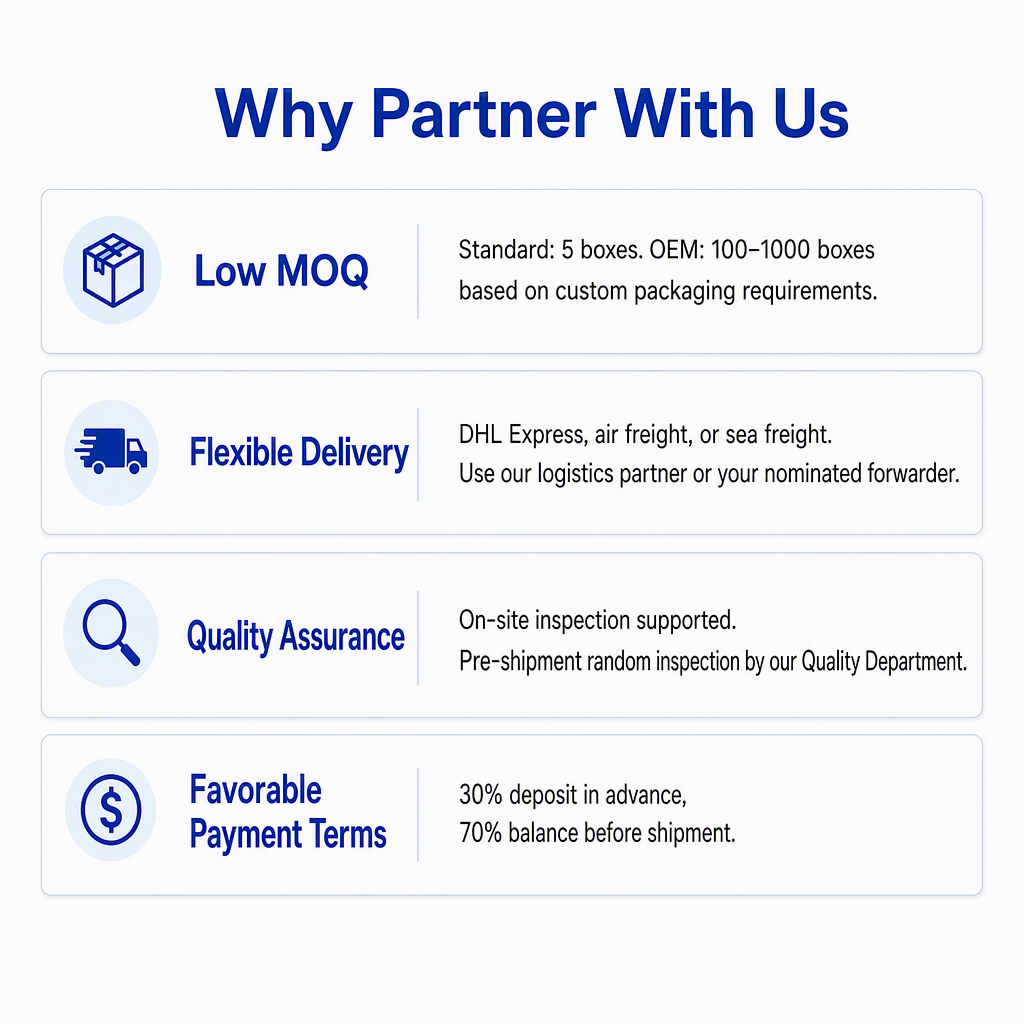
Purchasing support: MOQ structure, EXW/FCA/FOB/CFR delivery terms, on-site inspection and pre-shipment random inspection.
Have Questions or Need More Details?
Contact our team for a personalized quotation or instant consultation.
Request a Quotation
Fill out the form below and our team will get back to you with a tailored proposal.
WhatsApp Direct Chat
Prefer to chat in real-time? Message us on WhatsApp for instant assistance & quick answers.
- Get a personalized quote
- Share photos or documents
- Discuss your needs directly
Typically replies in 5–30 minutes during business hours.