
Teeth Whitening Strips Compliance Guide: Certifications, Standards and Region-Specific Evidence
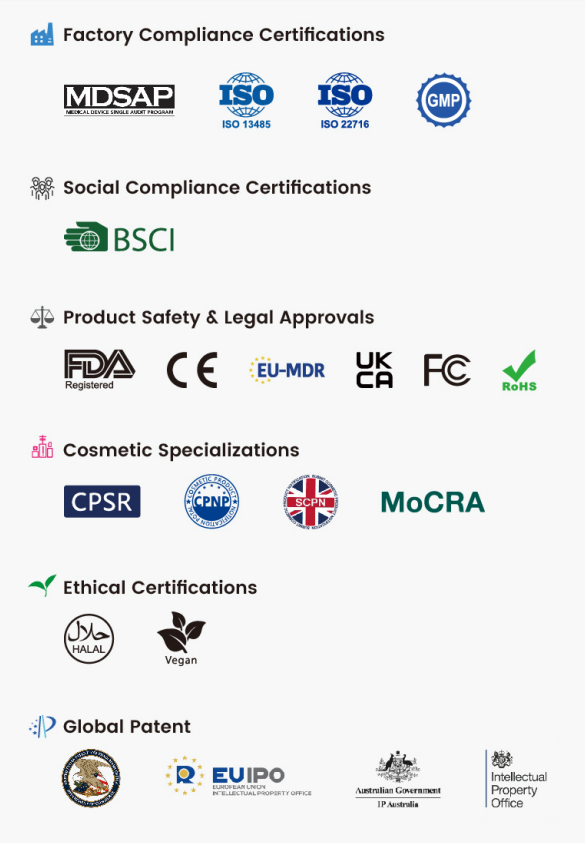
Every teeth whitening strips buyer eventually receives the same folder: MDSAP, ISO 13485, ISO 22716, GMP, BSCI, CE, CPSR, CPNP, PIF, MSDS, COA. The documents are usually genuine. The problem is that they are almost never what the buyer assumes they are.
A management-system certificate confirms how a factory is run. A facility registration confirms that a factory has been entered into a regulator's database. Only product-level documentation — safety reports, notifications, listings, technical files and test reports — speaks to the specific strip a brand intends to place on a shelf. Those three layers are routinely bundled into one PDF and presented as a single answer, and that is where most sourcing mistakes begin.
This guide separates the layers, maps the documents a European buyer and a US buyer should actually request, and shows how to read a supplier dossier without treating any certificate as automatic product approval. The reference example throughout is Glorysmile (Jiangxi Dentalbright Technology Co., Ltd.), a Chinese oral care manufacturer founded in 2008 whose current 36,000 m² factory was completed in 2013, with roughly 90% of output exported to the EU, USA and UK.
What a Whitening Strip Dossier Actually Contains
The central misunderstanding in whitening-strip procurement is a category error: buyers conflate certification of a system with authorisation of a product. A factory can hold every management-system certificate in the industry and still be unable to place a specific strip formulation into a specific market on a specific day.
Three failure modes account for most of the problem:
- Scope mismatch. A certificate covers a manufacturing site, a product family, or a process. It does not automatically extend to the exact SKU, flavour, or gel chemistry a brand has ordered.
- Classification mismatch. A peroxide strip sold as a cosmetic and a peroxide strip sold as a medical device travel through different regulatory routes in the same country. The certificate set that satisfies one route will not satisfy the other.
- Holder mismatch. Product-level registrations are held by a named legal entity. If that entity is not the party named on the import documents, the registration exists but does not cover the shipment.
A fourth risk sits behind all three: choosing an unqualified supplier directly affects import clearance and market sale. When the relevant qualification is absent, the product cannot be imported smoothly or sold, and the cost lands on the importer, not the factory.

Why Whitening Strips Sit in an Unusually Crowded Regulatory Space
Whitening strips are small, inexpensive and heavily marketed, which disguises how much regulation surrounds them. The global market for teeth whitening strips and gels was valued at USD 1.1 billion in 2025 according to Grand View Research, and cross-border sellers operate across at least three overlapping rule sets.
The first is customs. Teeth whitening strips are primarily classified under HS code 3306.90.00 for preparations of oral or dental hygiene, per a US Customs and Border Protection ruling. Getting this wrong creates duty and documentation friction before any regulator examines the product.
The second is formulation limits. EU Regulation (EC) No. 1223/2009 restricts hydrogen peroxide concentration in over-the-counter teeth whitening products to 0.1% or less. This matters because a factory may legitimately manufacture higher-concentration gel for clinic use or for markets with different rules, and a buyer may legitimately order it — but the same formulation cannot simply be moved into an EU over-the-counter channel. Concentration and channel must be decided together.
The third is market registration. Under the US MoCRA 2022, manufacturers of whitening strips classified as cosmetics must register facilities and list products, with published reference figures of USD 849 per year for facility registration and USD 200 per product listing. In the EU, cosmetic products follow the CPNP notification and Cosmetic Product Safety Report route, while medical-device-classified products follow MDR.
The practical consequence is that two brands buying visually identical strips can be operating under entirely different compliance obligations. A compliance guide that does not start with product classification will produce the wrong document list.
Reading the Five Management-System Certificates
These five certificates are the backbone of a whitening-strip supplier dossier. Each answers a different question, and none of them authorises a product for sale.
ISO 13485 — medical device quality management
ISO 13485 certifies that a manufacturer operates a quality management system built for medical devices, covering design control, risk management, traceability and corrective action. It is evidence that the factory can control a medical-device-grade process. It is not a product registration and does not, by itself, allow a device to be sold in any jurisdiction.
ISO 22716 — cosmetics good manufacturing practice
ISO 22716 sets out good manufacturing practice guidelines for cosmetics production, covering premises, equipment, raw materials, production, packaging and laboratory control. For a whitening strip sold as a cosmetic, this is the relevant manufacturing standard. It does not replace the Cosmetic Product Safety Report, and it does not constitute a market notification.
GMP — good manufacturing practice
GMP is the general manufacturing-practice framework referenced by regulators, including US GMP expectations for cosmetics. It confirms that production is controlled and documented. It says nothing about whether a particular formulation is permitted or a particular claim is allowed.
MDSAP — Medical Device Single Audit Program
MDSAP is a single audit programme that assesses a manufacturer's quality management system against the requirements of multiple participating medical-device regulators at once. It reduces audit duplication for manufacturers selling into several markets. It is frequently misread as a multi-country product approval. It is not: MDSAP is an audit outcome, and product registration remains a separate step in every market.
BSCI — social compliance
BSCI is a social compliance audit covering labour conditions, working hours, health and safety, and business ethics. It is a retail-supply-chain credential, not a product-safety credential. A BSCI report will satisfy a retailer's responsible-sourcing questionnaire; it will not satisfy a customs officer or a cosmetic regulator.
Glorysmile holds MDSAP, ISO 13485, ISO 22716, US GMP and BSCI certification, and the company also holds both medical device and cosmetics production licences. That combination matters for a specific reason: it means one factory can serve a cosmetic-route programme and a medical-device-route programme without the brand having to split its supply base. It still does not tell the brand which route its own SKU belongs to.
Facility Registration: The Layer Buyers Skip
Facility registration sits between system certification and product evidence, and it is the layer most often missing from a dossier pack because it produces a registration number rather than a framed certificate.
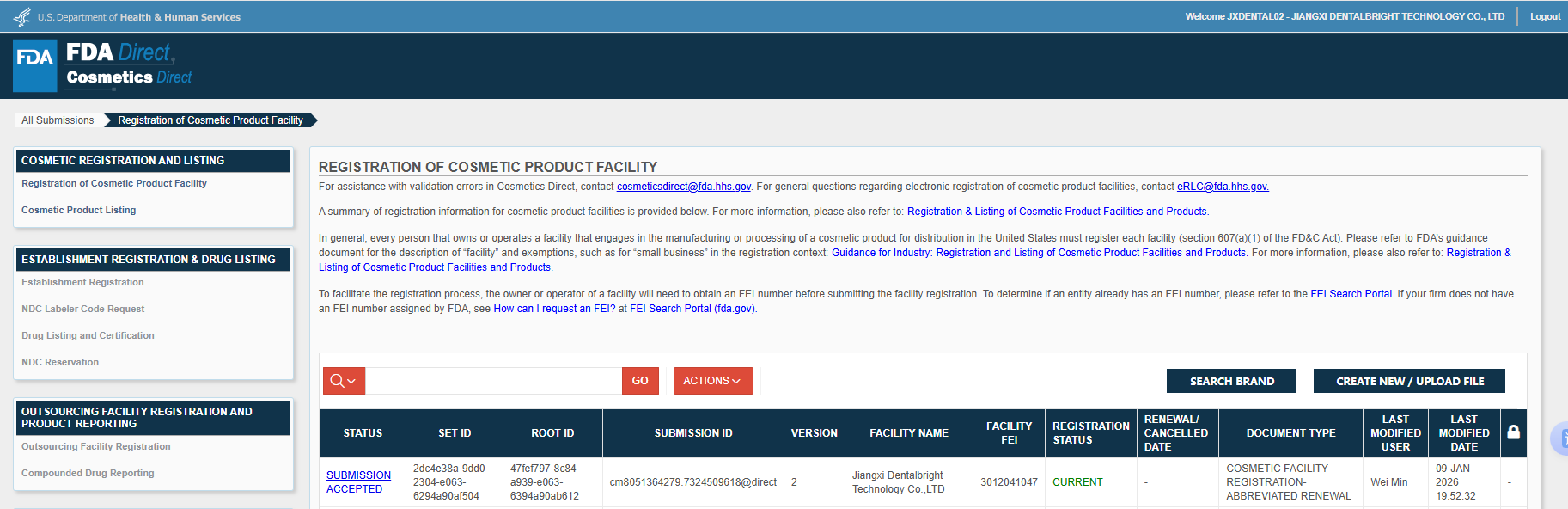
In the United States, MoCRA-compliant cosmetic facility registration and product listing are the operative steps for whitening strips classified as cosmetics. A US Agent is required, and product formulation filing must be completed on the FDA official website. Glorysmile has completed MoCRA-compliant cosmetic facility registration and product listing for teeth whitening strips for the US market.
For medical-device products, the equivalent layer is FDA establishment registration and device listing. Glorysmile's teeth whitening lights, electric toothbrushes and oral irrigators have obtained FDA medical device registration, and its silicone rubber impression material has completed 510(k) registration.
Note what this list does and does not say. It does not say that every strip SKU is a registered device. It says that specific named product categories have completed specific named registrations. That is the level of precision a buyer should demand in writing.
Product-Level Evidence: Where Actual Market Access Lives
Product-level documents are the only ones that address the strip itself. They fall into three groups.
Safety and technical files. The Cosmetic Product Safety Report (CPSR) and Product Information File (PIF) are EU cosmetic instruments. The CPSR assesses the formulation against safety limits; the PIF holds the product description, manufacturing method, safety assessment and supporting data. An MSDS describes hazard and handling information for the material, and a COA confirms the specification of a specific batch. None of these is a market authorisation, but each is routinely requested at import and by retail compliance teams.
Notifications and listings. CPNP notification registers a cosmetic product in the EU portal. MoCRA product listing registers a cosmetic product in the US. Both are notifications rather than approvals, and both are tied to the legal entity that files them.
Test reports. For EU-market cosmetic strips, the documentation set commonly includes microbiological limit testing, heavy-metal testing for lead, arsenic, mercury and cadmium, skin irritation testing and stability testing. These are the reports that turn a formulation claim into evidence.
Glorysmile can supply CPSR, CPNP and PIF for cosmetic products, and MSDS is available on request. Where a brand plans a medical-device route in Europe, the company's medical-device products hold MDR-CE certification with a complete Technical File and an appointed EU Responsible Person.
EU Document Requests: CPSR, CPNP, PIF and MDR-CE
A European buyer's request list should be built around the classification decision, not around a generic certificate bundle.
For a cosmetic-route whitening strip, the mandatory core is a CPSR, a CPNP notification confirmation, and EU Responsible Person information. Supporting documents typically include the product specification, MSDS and raw-material COA. Technical requirements include a compliant concentration of the whitening active ingredient, an adhesive strip substrate that does not break easily or overflow excess gel, and a pH value and odour within a safe range with no prohibited or over-limited ingredients.
For a medical-device-route product, the core is an MDR-CE certificate, a complete Technical File, and an appointed EU Responsible Person. The MDR route is more demanding and should be planned before packaging artwork is signed off, not after.
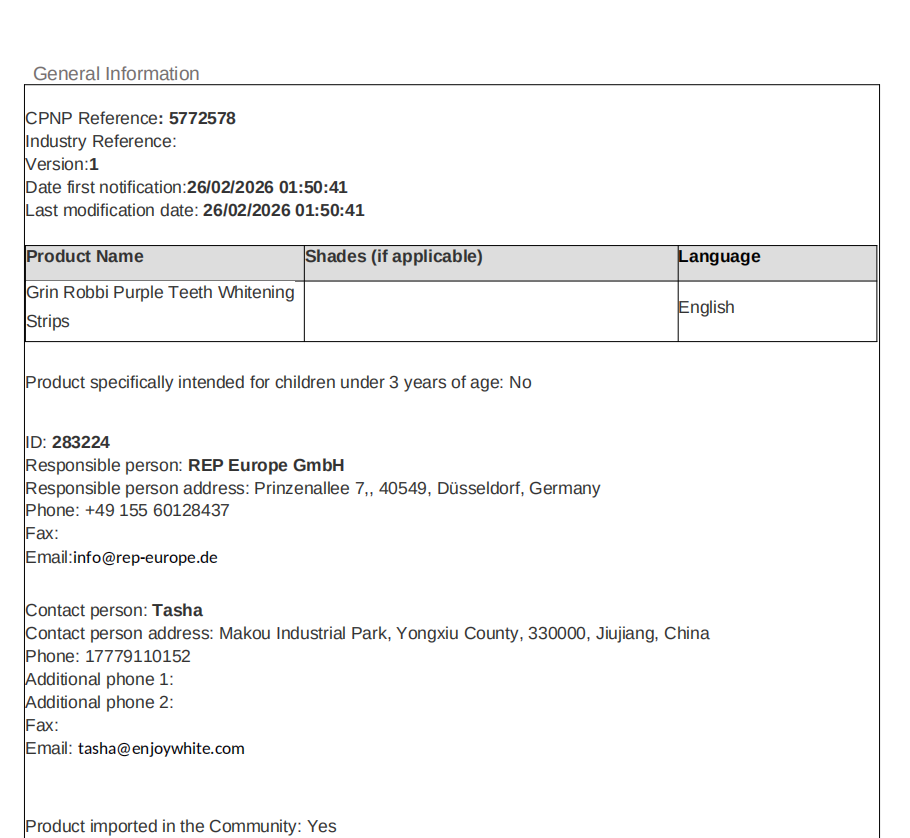
One question deserves to be asked explicitly in every EU negotiation: who is the Responsible Person named on the notification, and does that entity cover my import? A CPNP confirmation in a supplier's name does not automatically place a distributor's own brand on the market.
US Document Requests: MoCRA, FDA Registration and 510(k)
The US side has the same structure but a different vocabulary, and it carries the industry's most persistent wording problem: “FDA approved”.
Glorysmile's published FAQ response states that its products are FDA approved and that its FDA-certified scope covers medical devices, cosmetics and OTC drugs. That statement is accurate as a description of scope, but a careful buyer should break it into four separate questions before relying on it:
- Is the cosmetic facility registered and is the specific product listed under MoCRA?
- Is there a US Agent appointed, and has the formulation been filed?
- If the product is a device, is there an establishment registration and device listing?
- If a 510(k) applies, is the clearance document available and does it name the correct product?
Answering those four questions converts a marketing statement into a verifiable compliance position. It also protects the brand: a cosmetic listing and a device clearance are not interchangeable, and a retail compliance team will treat them differently.
A Seven-Step Dossier Review
The following sequence keeps a compliance review in the right order. Running the steps out of order is how brands end up holding a complete-looking folder that does not cover their product.
Step 1 — Classify the product before requesting documents
Decide cosmetic versus medical device based on formulation and intended claims, market by market. The classification determines which document set is even relevant.
Step 2 — Check the formulation against local concentration limits
For the EU over-the-counter route, confirm the hydrogen peroxide concentration sits at or below 0.1% under Regulation (EC) No. 1223/2009. Confirm the peroxide-free alternatives as well, since PAP-based strips follow a different evidence path.
Step 3 — Verify system certificates for scope, not existence
Ask which site, which product family and which validity period each certificate covers. A certificate for a different production site does not cover the order.
Step 4 — Confirm facility-level registrations
For the US, confirm MoCRA facility registration and product listing together with the US Agent appointment. For device categories, confirm establishment registration and any applicable 510(k).
Step 5 — Collect product-level documents
CPSR, PIF, CPNP confirmation and EU Responsible Person for Europe; MSDS, COA and specification for both markets; microbiological, heavy-metal, skin irritation and stability reports where applicable.
Step 6 — Audit label wording against the approved file
Strict regulatory compliance depends on precise label wording. Claims, ingredient names and concentration statements on the artwork must match the dossier, because the label is the document a regulator reads first.
Step 7 — Write the obligations into the purchase agreement
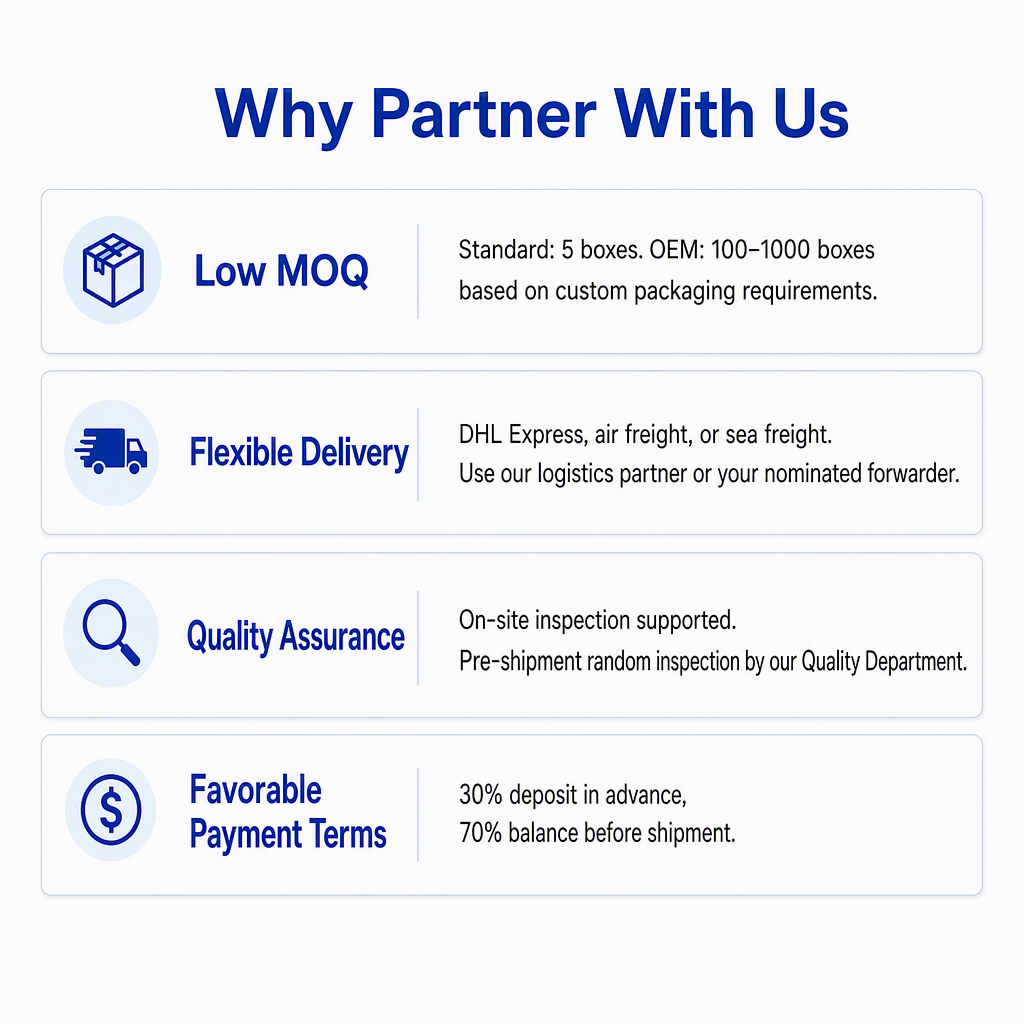
Name the document set as a delivery condition, require notification of any formulation or supplier change, and set acceptance criteria. Glorysmile supports on-site inspection and pre-shipment random inspection by its Quality Department, with payment terms of 30% deposit in advance and 70% balance before shipment, and delivery terms of EXW, FCA, FOB or CFR.

Four Buyer Scenarios
Scenario 1 — EU cosmetic brand launching a PAP+ strip. The route is cosmetic. The core request is CPSR, CPNP notification and PIF, plus the EU Responsible Person. Supporting documents include product specification, MSDS and raw-material COA, with microbiological, heavy-metal, irritation and stability testing. Because PAP is peroxide-free, the 0.1% hydrogen peroxide limit is not the binding constraint — but the safety report still governs the formulation.
Scenario 2 — EU brand using a peroxide strip at higher concentration. A higher-concentration formulation may be manufactured legitimately, but it does not travel through the EU over-the-counter cosmetic route. The classification and channel decision must be settled before ordering, or the shipment will be blocked at the border rather than at the factory gate.
Scenario 3 — US DTC brand selling on marketplaces. MoCRA facility registration and product listing are the operative filings, with a US Agent appointed and the formulation filed. Marketplace compliance teams increasingly ask for the listing reference rather than a certificate image, so the listing should be obtained at order stage.
Scenario 4 — Distributor building a long-term portfolio. Here the dossier is not a one-time purchase — it is an asset that must stay current. Reformulation, packaging change or a shift of production site can invalidate the file. A supplier with in-house regulatory capability across cosmetics, OTC drugs and medical devices reduces the risk of a mid-contract re-filing, which is why full-range regulatory coverage is a long-term partnership criterion rather than a nice-to-have.
Certification Comparison: What Each Document Proves
The table below summarises the layer each document belongs to and, more usefully, the claim it does not support. Treat the third column as the buyer's checklist.
| Document | What it certifies | What it does not prove | Primary market relevance |
|---|---|---|---|
| ISO 13485 | Medical-device quality management system at the manufacturing site | That a specific strip SKU is approved or registered | Global |
| ISO 22716 | Cosmetics good manufacturing practice in production and packaging | Product safety assessment or market notification | EU-oriented cosmetic supply |
| GMP | Controlled, documented manufacturing practice | That a formulation or claim is permitted | US and global |
| MDSAP | A single audit against multiple regulators' quality system requirements | Product registration in any single country | Multi-market device manufacturers |
| BSCI | Social compliance: labour, health and safety, ethics | Product safety or market access | Retail sourcing requirements |
| CPSR / PIF | Cosmetic safety assessment and product information file | That the notification has been filed by the right entity | EU |
| CPNP notification | Product notified in the EU cosmetic portal | That a distributor's own brand is covered | EU |
| MoCRA registration and listing | US cosmetic facility registered and product listed | An FDA “approval” of the product | US |
| MDR-CE certificate and Technical File | Medical-device conformity for the EU route | Cosmetic-route coverage for the same SKU | EU |
Region-by-Region Request List
This second table converts the document layers into a request list a buyer can send to a supplier. It deliberately starts with the classification question, because that answer changes everything after it.
| Region | First question to settle | Product-level documents to request | Facility-level documents | Common buyer misunderstanding |
|---|---|---|---|---|
| EU | Is the strip sold as a cosmetic or as a medical device? | CPSR, PIF, CPNP confirmation, EU Responsible Person, product specification, MSDS, raw-material COA, microbiological and heavy-metal test reports | ISO 22716 and GMP for cosmetic supply; MDR-CE certificate plus Technical File for device supply | Assuming a CPNP notification held by the factory automatically covers the distributor's own brand |
| US | Cosmetic listing or device registration? | MoCRA product listing reference, US Agent details, formulation filing, MSDS, COA, specification | MoCRA facility registration and product listing; FDA establishment registration and device listing; 510(k) clearance where applicable | Reading “FDA approved” as a single status rather than four separate filings |
| Both | Does the certificate name the site that will actually produce the order? | Batch COA matching the shipment; label wording aligned to the approved file | ISO 13485, MDSAP and BSCI as supporting system evidence | Accepting a certificate for a different site or an expired validity window |
Frequently Asked Questions
Does a supplier's CPSR, CPNP and PIF make a whitening strip compliant for the EU market?
They make a cosmetic-route product filable; they do not automatically make a specific shipment compliant. Glorysmile can offer CPSR, CPNP and PIF for cosmetic products, and for medical devices the company has also completed CE-MDR registration. The remaining conditions sit with the buyer: the notification must name the correct legal entity or Responsible Person, the formulation must respect EU concentration limits — hydrogen peroxide at 0.1% or less for over-the-counter products under Regulation (EC) No. 1223/2009 — and the label wording must match the approved file.
What certifications do Glorysmile's teeth whitening strips and factory hold?
Glorysmile lists its credentials in two groups. Factory certificates cover CE, FDA, CPSR, CPNP, PIF, SCPN, MSDS, COA, RoHS, HALAL and Vegan. Product and system certificates cover GMP, ISO 22716, ISO 13485, MDSAP and BSCI. The company also holds both medical device and cosmetics production licences. Strip formats include dry strips (GS-004H/V/C/P), wet strips (GS-V34-S07) and dissolving strips (DB-004L), each available in PAP, PAP with charcoal, purple, 6% HP, sodium phytate and sodium bicarbonate formulations, or custom.
How much does US MoCRA registration cost for a whitening strip brand?
Published reference figures for MoCRA 2022 are USD 849 per year for cosmetic facility registration and USD 200 per product listing. Those are filing fees, not total programme cost: a US Agent appointment and formulation filing are also required, and each additional SKU adds a listing. Glorysmile has completed MoCRA-compliant cosmetic facility registration and product listing for teeth whitening strips for the US market, which means a brand sourcing from this factory starts from an existing registration rather than a blank file.
Can a supplier provide MSDS, COA and product samples before a private-label order?
MSDS is available, and batch COA is issued against the product specification. On sampling, Glorysmile's OEM/ODM service includes product formulation, customization, free sampling and packaging design, so a brand can evaluate the strip, the flavour and the packaging before committing to volume. The minimum order quantity is 200 pieces for private label and 1 for regular product, which allows a small validation order before a full launch.
What lead time and customization turnaround should a buyer expect on a repeating order?
Glorysmile's published comparison data lists a 5–7 day lead time on standard strip lines and a 7–15 day customization turnaround for branded orders. For a distributor planning a rolling programme, the more important figure is capacity behind that lead time: the factory's annual output includes approximately 300,000,000 pieces of teeth whitening strips and 10,000,000 sets of teeth whitening kits, across a 36,000 m² facility with 20,000 m² of 100,000-class cleanrooms and a 1,000 m² laboratory with a 100-class cleanroom for microbiological testing. To start a document review or request samples and a quotation, contact Tasha at tasha@enjoywhite.com or via WhatsApp on +86 177 7911 0152.
Conclusion
A whitening-strip dossier is not a pass or fail document. It is a stack of evidence that answers different questions at different levels, and the buyer's job is to match each level to the market, the classification and the entity named on the import paperwork.
The rules that survive every review are simple. Classify before you request. Check the scope of every certificate, not its existence. Convert “FDA approved” and “EU compliant” into named filings and named entities. Keep the formulation inside the local concentration limit for the channel you are actually selling into. And write the document obligations into the purchase agreement, so that a reformulation or a site change triggers a notification rather than a surprise at customs.
Glorysmile's relevance to this process is not that it holds a long certificate list. It is that the list spans cosmetics, medical devices and OTC scope at a single 36,000 m² site exporting to 102 countries, with roughly 90% of output going to the EU, USA and UK. For a brand planning a multi-year whitening strip line, that breadth reduces the number of times the compliance file has to be rebuilt from scratch.
Review the dossier before you review the price
Request the product specification, MSDS, batch COA and certificate set for the specific strip format you intend to order, or download the full catalogue here: Glorysmile Product Catalogue (PDF).
Have Questions or Need More Details?
Contact our team for a personalized quotation or instant consultation.
Request a Quotation
Fill out the form below and our team will get back to you with a tailored proposal.
WhatsApp Direct Chat
Prefer to chat in real-time? Message us on WhatsApp for instant assistance & quick answers.
- Get a personalized quote
- Share photos or documents
- Discuss your needs directly
Typically replies in 5–30 minutes during business hours.