
Sensitive Teeth and Whitening Kits: A Problem-Solution Sourcing Guide for Brands
Sensitive Teeth and Whitening Kits: A Problem-Solution Sourcing Guide for Brands
Sensitive teeth are the most common reason a consumer abandons a whitening kit halfway through a course, and one of the most common reasons a private-label whitening product collects returns and negative reviews. For a brand sourcing a whitening kit, sensitivity is therefore not a marketing angle bolted onto an existing SKU. It is a formulation, format and documentation decision that has to be taken before sampling.

A private-label teeth whitening kit: the format is decided after the gel chemistry, not before it.
Jiangxi Dentalbright Technology Co., Ltd. (GlorySmile Factory) is an oral care manufacturer based in Yongxiu, Jiangxi Province, China. The company produces teeth whitening kits, whitening strips, whitening gels, whitening pens, toothpaste, mouthwash, toothpaste tablets and electric toothbrushes for OEM, ODM and private-label brands, and exports to 102 countries. This guide answers one sourcing question in detail: how do you build a whitening range that a sensitive-teeth user can actually finish?
The Problem: Sensitivity Breaks a Whitening Line in Three Places
The problem is chemical before it is cosmetic. Hydrogen peroxide (HP) and carbamide peroxide (CP) are small-molecule actives. They penetrate the enamel into the dentin and break down deep-seated pigments through free-radical oxidation. That is why peroxide gels whiten quickly and visibly, and also why they are the actives most likely to cause temporary tooth sensitivity.
PAP (phthalimidoperoxycaproic acid) works on a different principle. Its large molecular size prevents it from penetrating the tooth structure, so it oxidises surface stains only. The result is a gentler, enamel-friendly profile with minimal sensitivity, and a slower visible result on deep, stubborn stains.
For a brand, that single formulation difference lands in three commercial places:
- Market pathway. Peroxide whitening is strictly regulated as a drug in most markets, while PAP is chemically stable and easier to launch as a cosmetic in most countries. In the European Union, whitening products containing between 0.1% and 6% hydrogen peroxide require a first treatment by a dentist (Directive 2011/84/EU).
- Completion rate. A product that hurts is a product that is not finished, which shows up in returns rather than in test data.
- Positioning. A peroxide-free line can be sold to the sensitivity-first shopper without carrying the drug classification of a peroxide product in the same catalogue.
Physical format matters as well. Tray-based kits are used once per day for 10 to 30 minutes per treatment in home whitening scenarios, so tray material and fit influence the experience. The specification used for these applications is a Food Grade TPE mouth tray with a BPA-free requirement.
Industry Background: Gentle Whitening Is Now the Mainstream Segment
The sensitivity conversation is no longer a niche request. It sits inside the fastest-moving part of the whitening market:
- The global teeth whitening market was valued at USD 8.93 billion in 2025 and is projected to reach USD 14.31 billion by 2034 (Fortune Business Insights, 2026).
- The individual / at-home segment accounted for 68.67% of the teeth whitening market in 2024 (Straits Research) — the segment that private-label brands compete in.
- Asia Pacific held a 33.80% market share in 2025, the leading region globally (Facts & Stats).
- Demand for PAP+ (phthalimidoperoxycaproic acid) based peroxide-free whitening kits is described as surging as an alternative to traditional peroxide because of sensitivity concerns (The Insight Partners).
- The US FDA recognises ISO 28399:2021 as a consensus standard for external tooth bleaching products — a practical reference when you ask a supplier which standard a formula has been tested against.
The sourcing consequence is straightforward. Formula questions now arrive at the sampling stage rather than after launch, and distributors increasingly ask for the compliance file at the same time as the price list. A supplier that can answer the sensitivity question in writing, and then support it with documents, removes weeks from a product launch.
The Solution: How a Sensitive-Teeth Whitening Range Is Actually Built
1. Choose the gel chemistry deliberately, not by default
The gel is where sensitivity is decided. GlorySmile formulates Hydrogen Peroxide, Carbamide Peroxide, PAP, Sodium Phytate, Sodium Bicarbonate and Charcoal, with fully custom formulation available, and states that it offers PAP and low-sensitivity formulas designed for sensitive teeth.
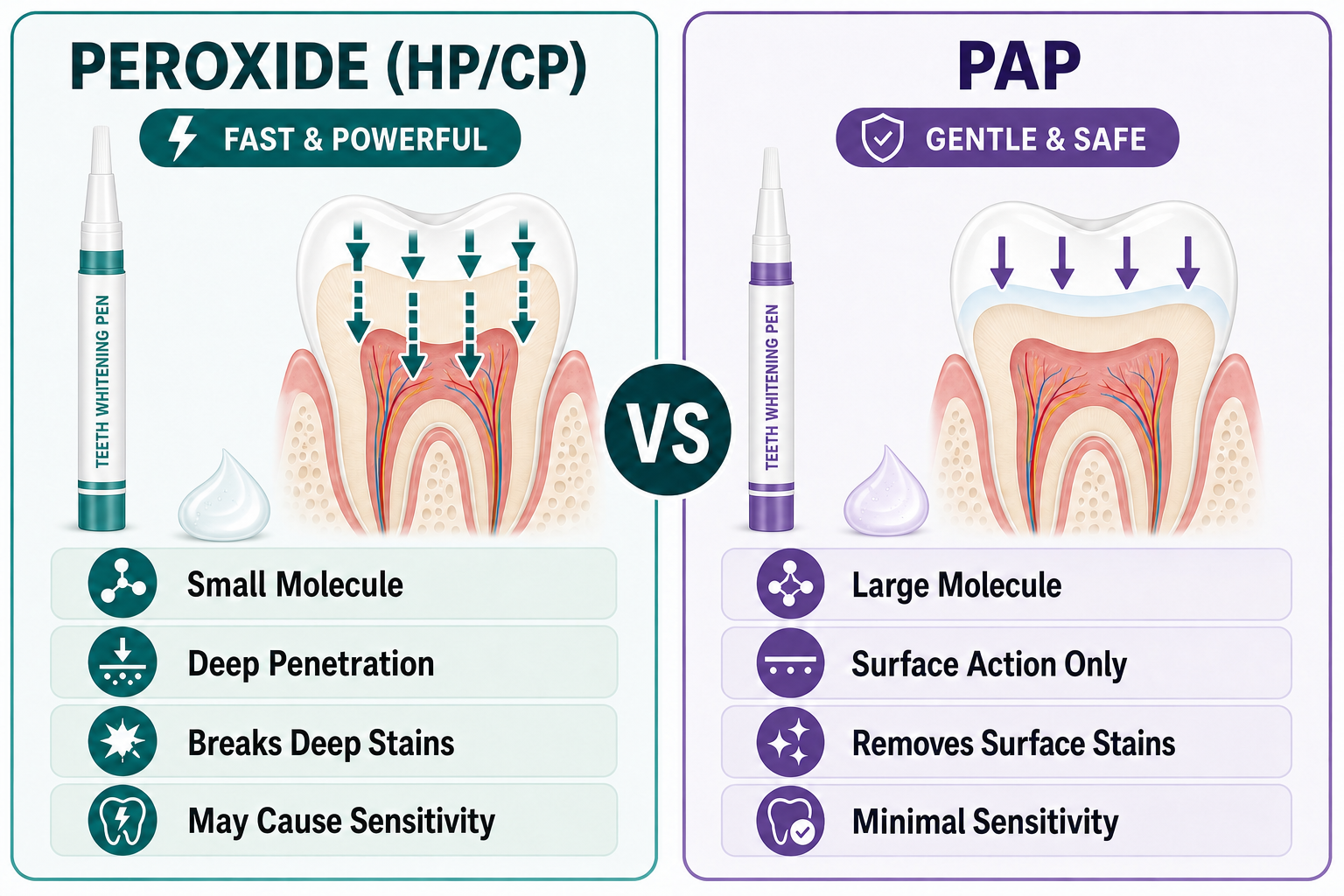
Peroxide gel versus PAP gel: penetration depth is what separates fast results from a gentle profile.
The working rule for buyers is simple. If intensity is the purchase driver and the market pathway for a peroxide product is clear, a hydrogen peroxide or carbamide peroxide gel delivers the fastest visible change. If the target buyer is sensitivity-first, or the product is intended for daily, long-term maintenance whitening, PAP is the lower-risk choice — it just needs more time on deep stains. PAP also travels further as a product concept: the same active appears in a dedicated PAP+ whitening powder (GS-005P), in a purple colour corrector powder (GS-005V), and in a double-tube toothpaste (GS-007D) alongside hydrogen peroxide.
2. Match the physical format to the sensitivity profile
Strip formats are not interchangeable, and the difference is measurable at the sourcing desk. Dry strips offer good adhesiveness, do not slip off easily and leave minimal residue, but they cost more. Wet strips have weaker adhesion, tend to shift during application and leave relatively more residue, which is why they are the lower-cost option — and why wet strips are the recommended format for purple whitening strips, where the higher residue helps the purple pigment adhere to the teeth. Dissolving strips (model DB-004L) are positioned differently again: residue-free and alcohol-free, and described as suitable for sensitive users.
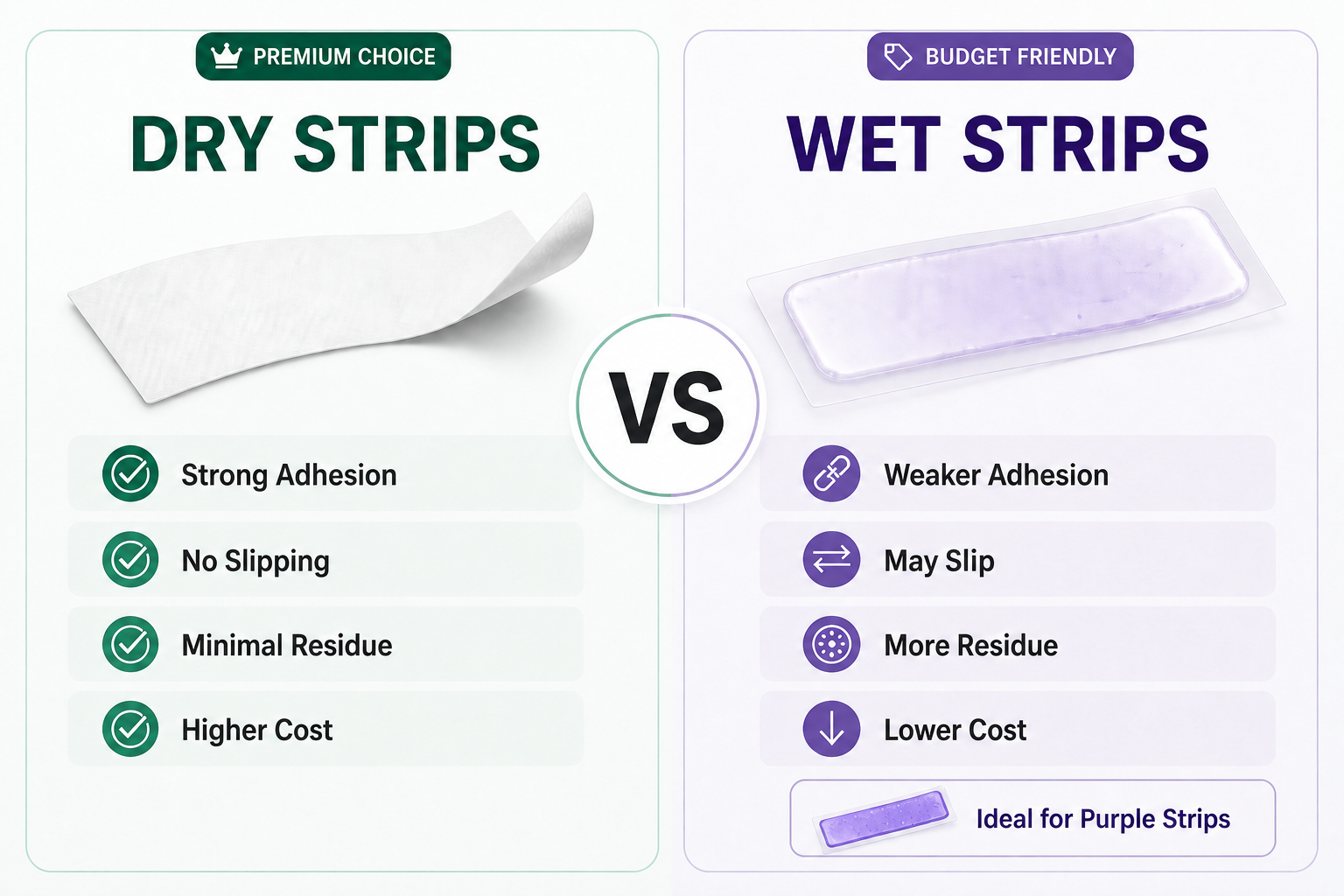
Dry strips versus wet strips: adhesion, residue and cost move together.
On the device side, the kit format determines how long a user holds the product in their mouth. The GS-001B kit runs 10 minutes per treatment for up to 40 uses; GS-001Y uses a 10-minute timer for 30 uses; GS-001X and DB-001M run 16-minute cycles with 32 LEDs and a storage or sterilisation case; GS-001J runs 16 minutes per day with 16 LEDs and plug-and-play USB power from a phone, laptop or power bank. Shorter, more controlled sessions are easier to position for a sensitivity-conscious buyer than long, high-intensity protocols.
3. Build the gentler daily regime around the kit
A sensitive-teeth line rarely stops at one SKU. Lower-intensity companion products let a consumer stay in the category between whitening courses, and they widen the basket without pushing a stronger bleach into the routine.
- Toothpaste tablets (GS-008). 30 or 60 tablets in rectangle, round or oval shapes, mint flavour, with purple, charcoal and sakura variants, and packaging options that include plastic jar, glass jar, aluminium jar or kraft bag.
- Denture cleansing tablets (GS-008D). 60 round tablets for dentures, mouthguards, retainers and other dental appliances — relevant for the aligner and retainer user who whitens.
- Purple colour corrector foam (GS-006V). 30 ml. Purple is directly opposite yellow on the colour wheel and is therefore its complementary colour, so a water-soluble purple dye is applied to the teeth to cancel out yellow undertones. The same logic is used in a 30 ml colour corrector serum and in a 65 g / 120 g purple colour corrector toothpaste (DB-007P).
- Mouthwash and spray. A 237 ml liquid mouthwash (DB-010S) that is alcohol-free and functions as a breath freshener and stain remover, a foam mouthwash (GS-010F) applied as two pumps swished for 30 to 60 seconds, and a 17 ml mouth spray (GS-011).
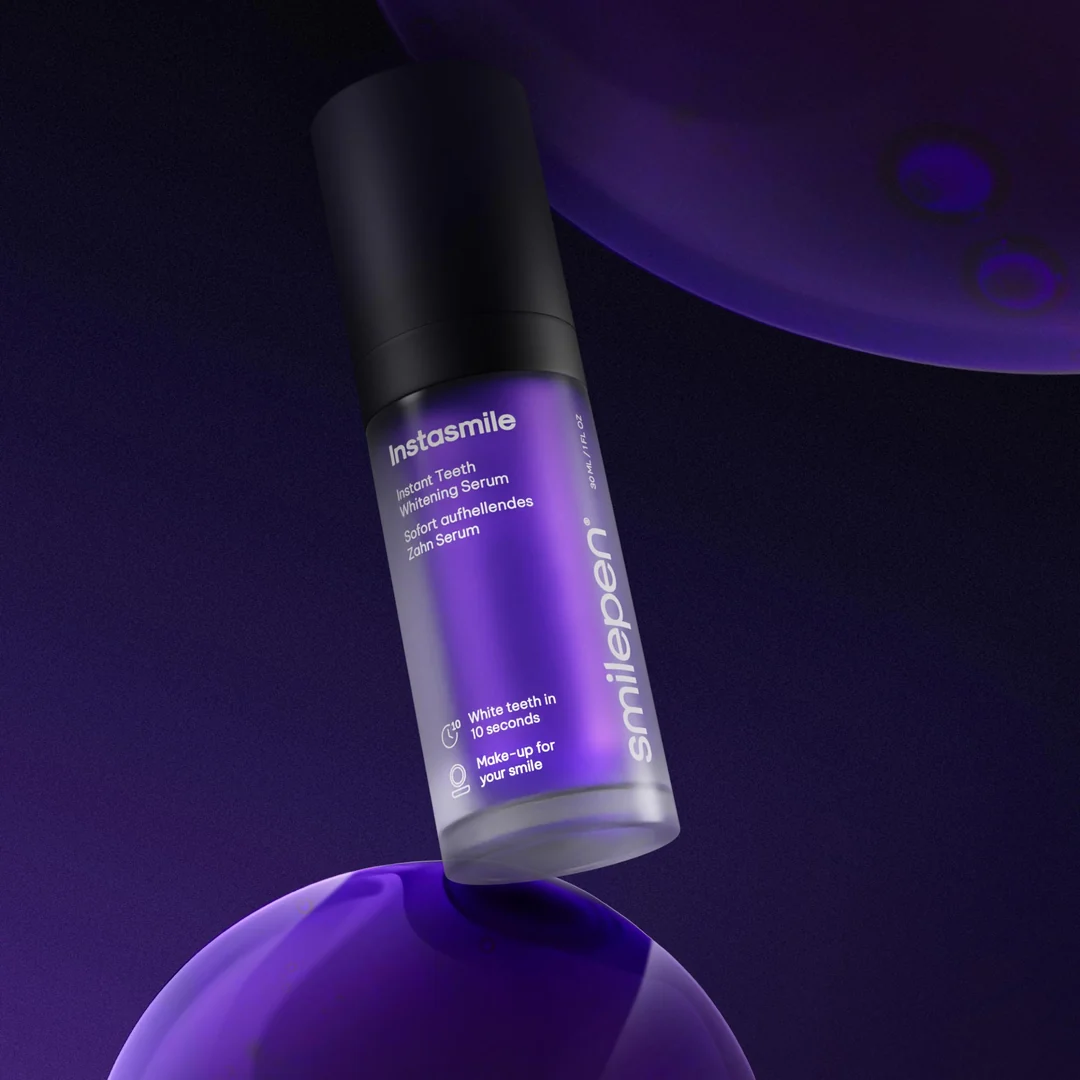
Purple colour correctors neutralise yellow undertones by complementary colour rather than by bleaching.
Step-by-Step Breakdown: A Seven-Step Sourcing Workflow
Step 1 — Define the market and the claim before the product. A peroxide formula and a PAP formula can lead to different product classifications in the same catalogue. Decide which market you are launching into, and which claim the artwork will carry, before a single sample is produced.
Step 2 — Confirm the whitening formula in writing. Ask the supplier to name the active and the concentration, and to state whether it is PAP (peroxide-free), carbamide peroxide, or hydrogen peroxide. Available options include Hydrogen Peroxide, Carbamide Peroxide, PAP, Sodium Phytate, Sodium Bicarbonate, Charcoal and fully custom formulations. A reply that says only 'whitening gel' is not an answer.
Step 3 — Ask the sensitivity question directly. The question to put in writing is: is this formulation designed for sensitive teeth, and what is the low-sensitivity alternative? Expect a PAP answer. At the same time, confirm the tray material (Food Grade TPE) and the BPA-free requirement for the mouth tray.
Step 4 — Select the delivery format. Choose between dry strips, wet strips, dissolving strips and LED kits according to the buyer profile, then confirm strip type, active ingredient, and whether the residue-free or standard formulation applies.
Step 5 — Assemble the companion products. Fix the daily-maintenance layer — toothpaste tablets, purple colour corrector, mouthwash or spray — at the same time as the kit, so packaging artwork and compliance documents are handled once.
Step 6 — Verify the compliance file. Request MSDS, which is available, plus COA and the market-specific documents listed in the FAQ below. Documentation should be checked with expiry dates in hand rather than assumed.
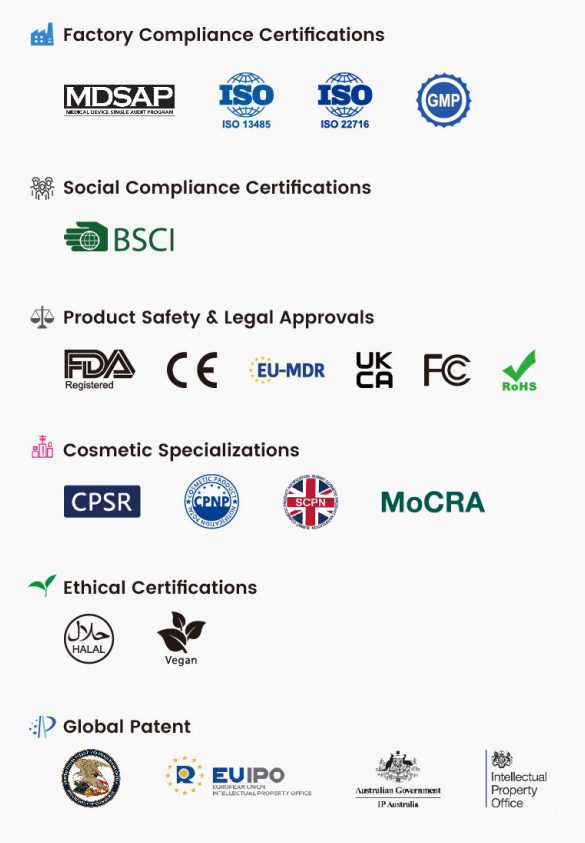
Compliance documents are checked at the sourcing stage, not after the packaging is printed.
Step 7 — Validate with samples, then lock commercial terms. Free sampling is part of the OEM/ODM service, together with professional package design. Once the sample is approved, confirm:
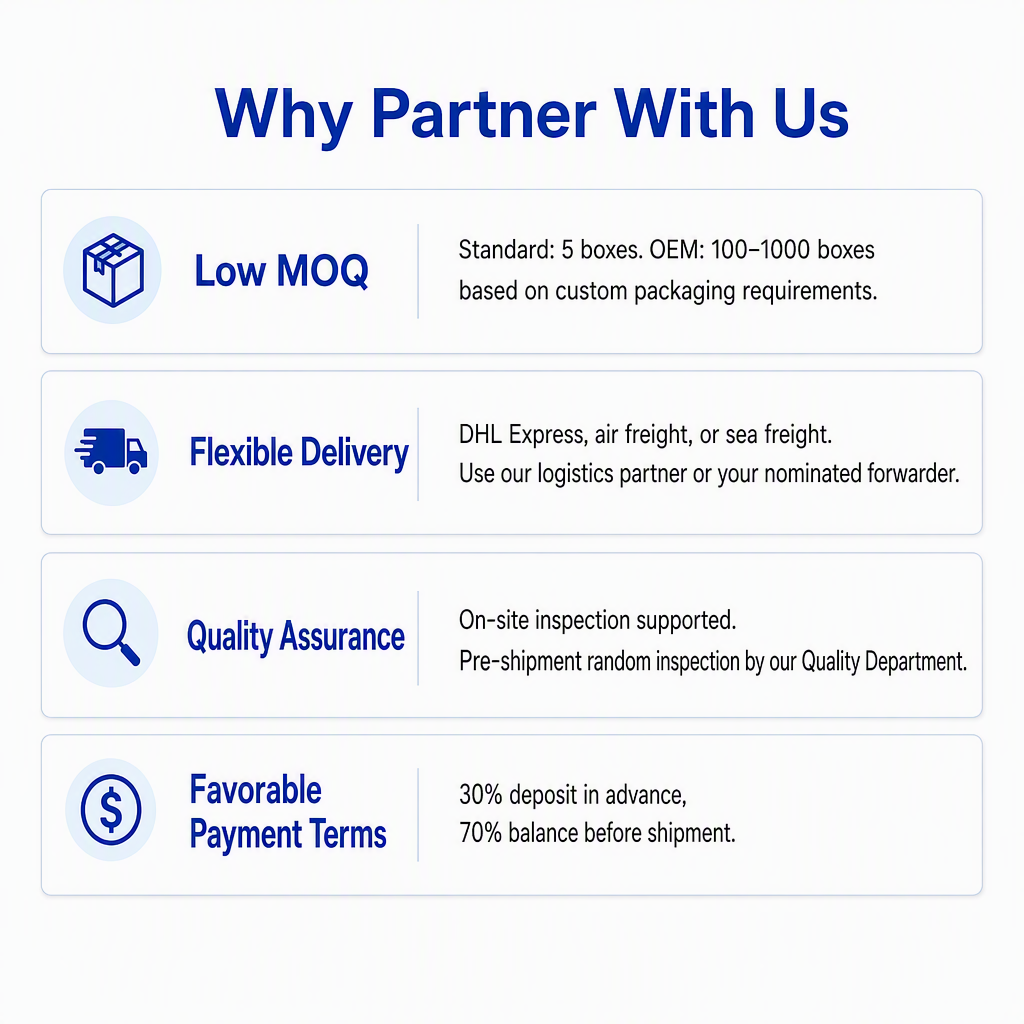
- MOQ. Kit specifications list 200 pcs for private label and 1 pc for regular product; standard packaging orders start from as few as 5 boxes, while OEM orders with custom packaging range from 100 to 1,000 boxes depending on the packaging minimum.
- Capacity. 105,000 sets per month for whitening kits, 8.33 million sets for whitening gel, 29.2 million pieces for strips, 21 million pieces for whitening pens, 830,000 toothpaste tubes, 2.5 million mouthwash sachets and 416,000 bottles, and 300,000 electric toothbrushes per month.
- Manufacturing environment. A 36,000 m² facility with 20,000 m² of 100,000-class cleanrooms and a 1,000 m² laboratory including a 100-class cleanroom for microbiological testing, staffed by 256 employees of whom 17 are R&D engineers and 11 are QC specialists.
- Trade terms. EXW / FCA / FOB / CFR, 30% deposit in advance with 70% balance before shipment, on-site inspection supported and pre-shipment random inspection available through the Quality Department.
- Lead time. Lead time varies with order volume, product specifications, customisation complexity and current production schedule; a precise delivery timeline is confirmed at order.
- Import classification. US Customs classified teeth whitening strips from China under subheading 3306.90.0000, identifying the whitening strips as the essential character of the product (CBP ruling NY N342147) — useful when modelling duty and landed cost.
Use Cases: Three Channel Models for Sensitive-Teeth Whitening
E-commerce private label. A platform seller building a private-label brand reached 1 million units over two years and achieved Top 10 Bestseller status in its category with a 4.8-star user rating. The customization brief included eco-friendly packaging, an FDA and CE compliant formula, and a low MOQ for initial testing — the pattern that fits a sensitive-teeth launch where the first production run is deliberately small.
Pharmacy chains and supermarket gift sets. A promotional gift-set programme delivered 7 million units across multiple sets, passed third-party factory audits (BSCI / ISO), recorded a zero return rate in large-batch inspection, and used multi-language manual customization with bulk pricing. For a sensitive-teeth range, gift sets are the natural container for a kit plus toothpaste tablets or a colour corrector.
Dental clinics and salons. A clinic-channel programme covering roughly 500,000 units reported whitening of 5 to 8 shades in a single treatment and zero sensitivity reports across more than 5,000 patients. The clinic format used there is the GS-001L clinic-use kit, built around a 35% hydrogen peroxide dual-barrier whitening gel with a gum protector and curved needles, cheek retractor, brush-ups and vitamin-E swabs. The same channel also uses silicone dental impression material (GS-009) with a hardness of 60, a one-minute working time and a 2.5-minute intraoral cure.
Comparison Table: Gentle Whitening Options and Kit Specifications
The table below summarises what each option is, where it fits, and what a buyer should confirm before committing.
| Option | How it works | Sensitivity profile | Best suited to | Confirm with the supplier |
|---|---|---|---|---|
| PAP gel (peroxide-free) | Large-molecule, surface-acting oxidation | Minimal sensitivity; enamel-friendly; chemically stable | Sensitive-teeth users; daily, long-term maintenance whitening | Active name and concentration; PAP or PAP+; cosmetic or drug pathway in the target market |
| Hydrogen peroxide (HP) / carbamide peroxide (CP) gel | Small-molecule; penetrates enamel into dentin; free-radical oxidation of deep pigments | Fast and dramatic results; more likely to cause temporary sensitivity | Buyers prioritising whitening intensity | Exact percentage; EU rule requiring a first dentist treatment for 0.1%–6% HP; market registration route |
| Dry strips | High-viscosity adhesive strip; residue-free options available | Minimal residue; sensitivity still governed by the active | Brands wanting strong adhesion and a low-residue experience | Strip type; active ingredient; whether the residue-free formulation is used |
| Wet strips | Lower adhesion; leaves relatively more residue | Not defined by sensitivity; chosen mainly on cost and pigment adhesion | Budget-conscious programmes; purple / V34 strip lines | Which active is used; compatibility with purple pigment |
| Dissolving strips (DB-004L) | Dissolving format; residue-free and alcohol-free | Positioned as suitable for sensitive users | Strip lines positioned for sensitive teeth | Whether the alcohol-free and residue-free claims are documented |
| Purple colour corrector (foam / serum / toothpaste) | Purple is opposite yellow on the colour wheel and cancels yellow undertones | No bleaching active required for the tint effect | Daily maintenance and low-intensity SKUs | Format and size: 30 ml foam or serum, 65 g / 120 g toothpaste |
| Clinic-use kit (GS-001L) | 35% hydrogen peroxide dual-barrier gel with gum protector | Professional setting with barrier protection | Clinics, salons, professional channels | Whether professional-strength use is permitted in the target market |
For brands comparing hardware, the kit specifications differ in LED count, contents and power supply — the variables that most affect unit economics and the sensitivity message.
| Model | LED light | Contents | Treatment time | Power |
|---|---|---|---|---|
| GS-001B | 5 LED | Mouth tray, 3 × 3 ml whitening syringe, shade guide, user manual, gift box | 10 minutes, up to 40 uses | 2 × CR2032 lithium metal batteries |
| GS-001Y | 5 LED | Mouth tray, 3 × 3 ml whitening syringe, shade guide, user manual, gift box | 10-minute timer, 30 uses | 2 × CR2450 lithium metal batteries |
| GS-001X | 32 LED | 2 × 3 ml whitening pen, charging and sterilisation case with cable, shade guide, user manual, gift box | 16 minutes; 3-minute disinfection cycle | 150 mAh lithium-ion; 4-hour charge; up to 5 uses per charge |
| DB-001M | 32 LED | 4 × 2 ml whitening pen, storage case with cable, shade guide, user manual, gift box | 16 minutes | 450 mAh lithium-ion; 2–3 hour charge; up to 8 uses per charge |
| GS-001J | 16 LED | 4 × 2 ml whitening pen, dust-free cover, 4 adapters (iPhone / Android / Type-C / USB), shade guide, user manual, gift box | 16 minutes per day | USB plug-and-play, powered by phone, laptop or power bank; no built-in battery |
All five kits use a Food Grade TPE mouth tray with a hard cardboard gift box, and support custom packaging, custom gel ingredient and custom pen or light colour. Kit-level private-label MOQ is 200 pcs.
FAQ
Is it compliant for the EU market?
Yes. CPSR, CPNP and PIF can be offered for cosmetic products, and for medical devices CE-MDR registration has also been completed. Note that the formulation itself determines the pathway: in the EU, products containing between 0.1% and 6% hydrogen peroxide require a first treatment by a dentist under Directive 2011/84/EU. That is one reason a PAP, peroxide-free formula is often the simpler route for a consumer cosmetic claim. Confirm the classification of your specific formula before artwork is finalised.
Can you provide MSDS?
Yes, MSDS is available. The wider document set covers factory certificates including CE, FDA, CPSR, CPNP, PIF, SCPN, MSDS, COA, RoHS, HALAL and Vegan, and product certificates including GMP, ISO 22716, ISO 13485, MDSAP and BSCI. Two certificates are worth checking with dates: the VEGAN certificate (No. 22521, issued 20 April 2024, valid to 21 April 2027, covering 23 SKUs) and the HALAL certificate (No. 52185957421871, issued 29 November 2023, valid to 21 November 2026, covering 22 SKUs).
Is the product safe for sensitive teeth, and how do I verify that with a supplier?
PAP and low-sensitivity formulas are offered and designed for sensitive teeth. Verify three things before approving a sample: the active ingredient and whether it is peroxide-free; the format, since dissolving strips such as DB-004L are residue-free and alcohol-free and dry strips leave minimal residue; and the tray material, which is Food Grade TPE with a BPA-free requirement for home whitening applications.
Is the product FDA approved, and what FDA-related registration applies?
Yes, the products are FDA approved, and the FDA-certified scope covers medical devices, cosmetics and OTC drugs. More specifically, teeth-whitening lights, electric toothbrushes and oral irrigators hold FDA medical device registration; the silicone dental impression material has completed 510(k) registration; and MoCRA-compliant cosmetic facility registration and product listing have been completed for the teeth-whitening strips for the US market. Separately, the US FDA recognises ISO 28399:2021 as a consensus standard for external tooth bleaching products, which is a useful benchmark when comparing formulations from different suppliers.
What is the MOQ and lead time for a private-label sensitive-teeth whitening kit?
Kit specifications list 200 pcs for private label and 1 pc for regular product, while standard packaging orders start from as few as 5 boxes; OEM orders with custom packaging range from 100 to 1,000 boxes depending on the packaging minimum. Monthly capacity for whitening kits is 105,000 sets, supported by 8.33 million sets of whitening gel capacity per month. Lead time varies depending on order volume, product specifications, customisation complexity and the current production schedule, and a precise delivery timeline is provided upon order confirmation.
Can I validate the project with a sample first?
Yes. Free sampling and professional package design are part of the OEM/ODM service, and commercial terms are set after the sample is approved: EXW / FCA / FOB / CFR, with 30% deposit in advance and 70% balance before shipment, plus on-site inspection support and pre-shipment random inspection through the Quality Department. To move a sensitive-teeth range from concept to shelf, download the product catalogue, or send the target market, formula direction and packaging brief to tasha@enjoywhite.com or WhatsApp +86 177 7911 0152 for a formulation recommendation and quotation.
Conclusion: Sensitivity Is Solved at the Specification Stage
A whitening kit for sensitive teeth is not a softer version of a standard kit. It is a different specification: a deliberate choice between peroxide and PAP chemistry, a strip or device format that matches how long the user will actually wear it, a daily-maintenance layer built from toothpaste tablets, a purple colour corrector and an alcohol-free mouthwash, and a compliance file that supports the claim in each market. Brands that fix those four elements before sampling avoid the most expensive outcome in this category — a finished product that a sensitive-teeth customer cannot finish.

Whitening kits are assembled in a 36,000 m² facility with 20,000 m² of 100,000-class cleanrooms.
Next step: brief, sample, and specification
Send your target market and sensitivity positioning, and the team will recommend a PAP or peroxide formulation, the matching format, and the compliance documents required for that market.
Download the catalogue: GlorySmile Product Catalogue (PDF)
Website: www.glorysmile.com
Contact: Tasha — tasha@enjoywhite.com · WhatsApp / Tel: +86 177 7911 0152
Have Questions or Need More Details?
Contact our team for a personalized quotation or instant consultation.
Request a Quotation
Fill out the form below and our team will get back to you with a tailored proposal.
WhatsApp Direct Chat
Prefer to chat in real-time? Message us on WhatsApp for instant assistance & quick answers.
- Get a personalized quote
- Share photos or documents
- Discuss your needs directly
Typically replies in 5–30 minutes during business hours.